









Introduction
India’s investment landscape has never offered more structured choice. Four distinct SEBI-regulated vehicles now serve investors across different wealth levels, strategy needs, and time horizons.
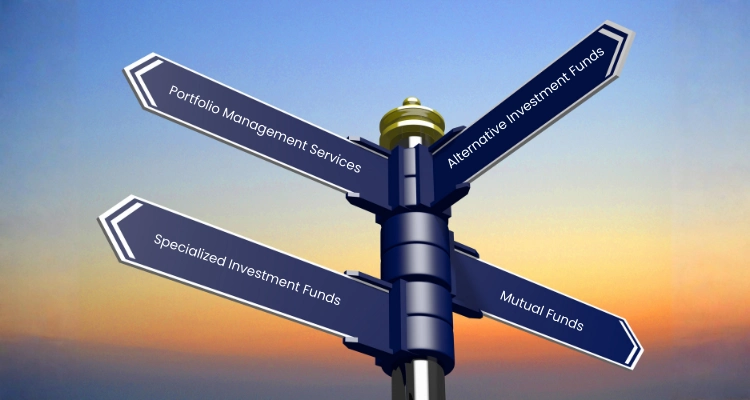
Mutual Funds, Portfolio Management Services (PMS), Alternative Investment Funds (AIFs), and the newly introduced Specialized Investment Funds (SIFs) each serve a specific investor profile. Understanding what separates them is essential before committing capital.
This guide breaks down how each vehicle works, where it sits in the investing spectrum, and what an investor should consider before choosing.
Key Takeaways
- Mutual Funds: Start at ₹500 via SIP. Highly liquid, diversified, and accessible for all investor types under SEBI regulation.
- SIF (Specialized Investment Fund): New SEBI category operational from April 2025. Minimum ₹10 lakh. Offers long-short strategies within a mutual fund framework.
- PMS (Portfolio Management Service): Minimum ₹50 lakh. Individual demat-held portfolios customized to the investor’s objectives.
- AIF (Alternative Investment Fund): Minimum ₹1 crore. Covers private equity, credit, hedge, and other alternative strategies for sophisticated investors.
- Market Scale: Mutual fund AUM stood at ₹82.03 lakh crore (Feb 2026), PMS AUM at ₹41.56 lakh crore (Jan 31, 2026), and AIF commitments at ₹15.74 lakh crore (Dec 2025).
Understanding Each Vehicle
Mutual Funds pool capital from retail and institutional investors into professionally managed portfolios. They are the most accessible and liquid of the four, with SEBI mandating daily NAV disclosures and strict scheme categorization.
SIFs were introduced by SEBI via a circular effective April 1, 2025. Only SEBI-registered AMCs can launch SIFs. They allow strategies like equity long-short, sector rotation, and hybrid long-short – tools previously reserved for PMS or AIF investors.
PMS provides a personalized portfolio held directly in the investor’s own demat account. A dedicated fund manager tailors the strategy to individual goals, making it highly flexible but also more concentrated than a mutual fund.
AIFs cover three categories: Category I (infrastructure, startup-focused), Category II (private equity, credit), and Category III (hedge funds, derivatives-based strategies). Each carries a distinct risk profile and lock-in requirement.
Comparison at a Glance
| Feature | Mutual Fund | SIF | PMS | AIF |
|---|---|---|---|---|
| Min. Investment | ₹500 (SIP) | ₹10 Lakh | ₹50 Lakh | ₹1 Crore |
| Regulator | SEBI | SEBI | SEBI | SEBI |
| Ownership | Pooled | Pooled | Individual Demat | Pooled / Trust |
| Strategy | Long-only | Long Short | Customized | Alternate Strat. |
| Liquidity | High | Moderate | Moderate | Low |
| Tax Treatment | MF Taxation | MF Taxation | Capital Gains | Pass-through |
| Ideal For | Retail / All | Mass Affluent | HNI | UHNI / Inst. |
India’s Growing Managed Funds Ecosystem
India’s managed funds industry has grown sharply. India’s managed funds industry currently stands at ₹212 lakh crore, projected to reach ₹455 lakh crore by 2030, according to Crisil Intelligence.
Within this, AIF commitments stood at ₹15.74 lakh crore as of December 2025, with actual investments at ₹6.45 lakh crore across 1,700+ registered AIFs – a 30% CAGR over five years, per SEBI Chairman Tuhin Kanta Pandey at the IVCA Conclave 2026.
Mutual fund AUM reached ₹83.43 lakh crore as of February 2026 (AMFI data), reflecting the deepening of retail participation across India.
PMS assets under management, as reported by SEBI’s Portfolio Manager data, stand at a Grand Total of ₹41.56 lakh crore as of January 31, 2026 – reflecting sustained and growing demand among high-net-worth investors for professionally managed, customized portfolios.
What Investors Should Consider
No single vehicle is universally superior. The right choice depends on investable surplus, liquidity needs, time horizon, and comfort with complexity.
Mutual Funds suit investors seeking simplicity and daily liquidity. SIFs suit those with ₹10 lakh or more who want access to sophisticated strategies within a regulated framework. PMS suits HNIs seeking a customized, actively managed portfolio. AIFs suit institutional or ultra-HNI investors with long-term capital and appetite for alternative strategies.
Each vehicle carries distinct costs, lock-in conditions, and tax implications. Independent evaluation against personal financial goals is essential before allocating capital.
Conclusion
India’s investment ecosystem now offers a well-structured spectrum – from ₹500 SIPs in mutual funds to ₹1 crore and above in AIFs. Each rung serves a different need, risk profile, and wealth stage.
The addition of SIFs in 2025 bridges a meaningful gap, offering sophisticated strategies to a broader base of investors without the exclusivity of PMS or AIF minimums.
At Steptrade Capital, the focus remains on identifying the right structure for long-term capital allocation across public and private markets. Reach out to Steptrade Capital to explore how each of these vehicles fits within a broader investment strategy.