







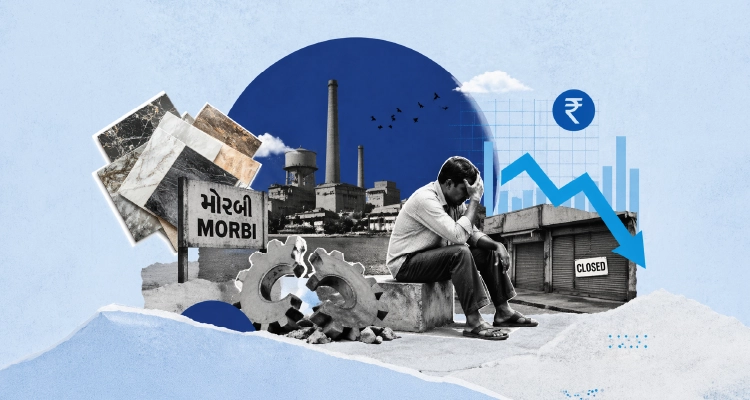
An international dispute, separated by thousands of miles, is breaking up the second-largest ceramics industry in the world. Almost 80% of Morbi’s ceramics producers have halted operations, due to a war they did not start.
The Ceramic Collapse
- Nearly 450 out of 670 factories have ceased operations. Kilns that demand uninterrupted heat at 1,200°C have simply gone cold.
- The primary source of Propane is Saudi Arabia and other West Asian nations, shipped via sea transport from the port of Kandla to Morbi through tankers around 130 kilometres away. With the onset of the international dispute, these supplies have been seriously affected.
- 97% of member factories voted for a complete one-month production shutdown.
But Morbi is not one Industry, it is an ecosystem. So, when the ceramic industry is facing crises, every industry connected to it is in crises
The Paper Mill Crises
Morbi’s ceramic manufacturers require kraft paper, which is used for the packing of all tiles and sanitary ware units produced and sold by Morbi’s ceramic factories. As there are about 53 paper mills in Morbi, all of which depend in some way on Morbi’s ceramic manufacturing, the lowest quality 12 BF fluting media mills will suffer the hardest – almost 80% of the production goes into packing ceramics. Some of these mills may see up to a 50% reduction in sales; running at less than full capacity will not generate profits but losses, forcing companies to compete in price reductions.
On the other hand, prices for imported waste paper, one of the main inputs, are forecast to go up by ₹4–5 per kg, but paper mills have no buyers to whom to transfer the increase.
Moreover, the threat does not lie just within the factory gates. China and Indonesia, losing West Asian markets, might try to export excess supplies to India at unreasonably low prices.
The Polypack Hit
Morbi’s polypropylene (polypack) packaging industry, which supplies woven bags and flexible packaging to the ceramic and industrial sectors, is being affected from both sides simultaneously.
The Middle East region represents more than 40% of polyethylene export volumes globally and almost 25% of polypropylene export volumes. From late February, polyethene prices have risen by almost 37% and polypropylene prices by more than 38%, touching a four-year high mark. The rise in the monthly price of polyethylene is reportedly the highest in 25 years.
Apart from the industrial disruption, this is a social and economic shock:
- Employment hit: With 80% of the factories shut down, daily wage workers are the first to be hit. With no formal contracts and zero income, early signs of reverse migration are being noticed in the country.
- Livelihood Disruptions: Transporters, truck drivers, loading/unloading workers, and warehouse staff lose daily earnings as demand for goods movement is on hold and the supply chain is facing major crises.
- Pressure on Localities- Demand for Rental Houses and Groceries faced major footfall due to the reverse migration of workers.
Morbi’s crisis highlights that industrial shutdowns are never stand-alone events.
Instead, they set off a domino effect through employment, consumption, and stability within society.
What began as a fuel shortage has turned into a livelihood crisis impacting not only the factories but the workforce behind them.
Read More:
- SME & Microcap Investing Through AIFs: A Family Office Perspective
- Biopharma SHAKTI: India’s ₹10,000 Crore Healthcare Push and the SME Opportunity
- Q4 FY2026 Earnings Preview: What SME and Microcap Investors Should Expect
- FY27 Begins – How Sophisticated Investors Should Reposition at the Start of a New Financial Year