







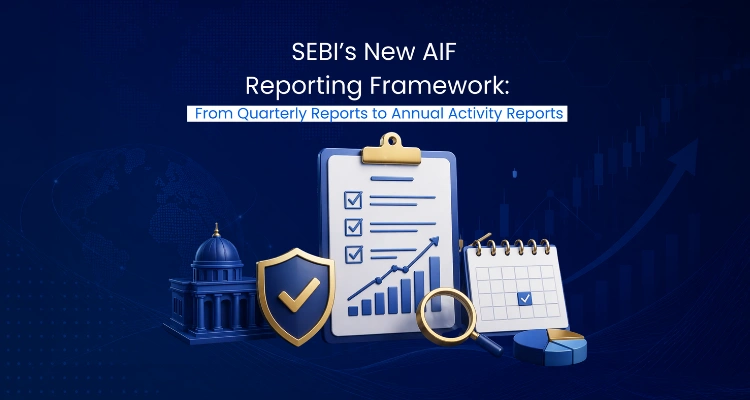
Something important changed for India’s AIF industry on March 4, 2026. SEBI replaced the old quarterly reporting regime with a two-tier structure: a comprehensive Annual Activity Report and a lighter Quarterly Activity Report. Every SEBI-registered AIF – Category I, II, and III – now operates under this revised framework.
At Steptrade Capital, a SEBI-registered AIF manager with ₹400 crore-plus AUM across Category II and III fund structures, regulatory reporting has always been treated as a governance priority. This change matters because the quality of what a fund discloses – and when – is one of the clearest signals of how seriously a manager takes their fiduciary responsibility.
This blog breaks down exactly what changed, why it happened, what the new reports cover, and what the May 31, 2026, deadline means in practice.
- New SEBI Circular, Immediate Effect: The SEBI circular dated March 4, 2026 (Circular No. HO/19/28/(1)2026-AFD-SEC3/I/6176/2026) introduced the revised AIF reporting framework, superseding Clause 15.1 of the SEBI Master Circular for AIFs dated May 7, 2024.
- Annual Activity Report (AAR): A comprehensive annual submission covering investment strategy, sector allocation, investor composition, fund performance, leverage, valuation practices, and compliance status. Due within 30 calendar days of March year-end.
- Quarterly Activity Report (QAR): A lighter filing due within 15 calendar days of the end of each June, September, and December quarter. No QAR is required for the March quarter – the AAR covers it fully.
- First Deadlines: The first AAR (for FY ending March 2026) is due by May 31, 2026. The first revised QAR is due for the quarter ending June 2026.
- AIF Industry Scale: India’s AIF sector held ₹15.74 lakh crore in total commitments and ₹6.45 lakh crore in actual investments as of December 2025 per SEBI data – the scale of capital this framework now governs.
- SEBI Risk Reminder: All AIF investments are subject to market risk and liquidity risk. Past fund performance does not guarantee future results. Always review fund documents carefully before making allocation decisions.
Why SEBI Changed the Rules
The old rules weren’t broken in isolation. Under Regulation 28 of the SEBI (Alternative Investment Funds) Regulations, 2012 and Clause 15.1.1 of the SEBI Master Circular, every AIF had to submit detailed quarterly activity reports within 15 days of each quarter-end. The format covers investor composition, leverage, portfolio concentration, investment activity, and exit data. Every quarter. In identical detail.
As the industry grew – crossing 1,700 registered funds and ₹15.74 lakh crore in commitments by late 2025 – four identical detailed filings a year started generating more administrative friction than regulatory clarity. SEBI’s Working Group on Ease of Doing Business and Reducing Cost of Compliance put the problem plainly: fragmented quarterly data was making regulatory analysis harder, not easier.
Importantly, this wasn’t a top-down decision made in isolation. The Indian Venture and Alternate Capital Association (IVCA) worked closely with SEBI through its regulatory committees, sharing ground-level feedback from AIF managers on the operational intensity of the earlier framework. That consultation shaped what the new structure looks like today.
The March 4, 2026 circular was the result. It consolidates substantive annual disclosures into one comprehensive document while retaining lighter quarterly touchpoints for ongoing monitoring. The goal: preserve transparency, reduce repetition.
The Two-Tier Structure: AAR and QAR Explained
The revised framework draws a clear line between depth and frequency. Depth goes into the Annual Activity Report. Frequency continues through the Quarterly Activity Report, but in a much lighter form.
The AAR is filed online through the SEBI Intermediary Portal (SI Portal) within 30 calendar days of March year-end. It is a comprehensive annual submission – everything that used to be spread across four quarterly filings now lives in one auditable annual document. All three categories of AIFs must file it.
The QAR continues for June, September, and December quarters, due within 15 calendar days of each quarter-end. But it captures only essential supervisory data – not the full scheme-level, investor-level, and portfolio-level disclosures that now belong in the AAR. There is no March quarter QAR: that quarter’s data is fully subsumed by the annual report.
The reporting formats have been designed by IVCA and published on their website within three days of the circular. IVCA is also supporting managers through the transition, including resolving format and submission queries. The shift to direct online filing through the SI Portal reduces manual interpretation of data, making the entire process cleaner and more consistent.
What the Annual Activity Report Covers
The AAR is built to give SEBI a full-year view of how a fund has been managed – not just what it invested in, but how it priced those investments, how much leverage it used, and whether it stayed compliant with its own PPM.
On the investment side, it captures sector and geographic allocation, the status of each portfolio holding, exits completed during the year, and leverage employed at both the fund and investee company level. Category III AIFs, which are permitted to use leverage, face particular scrutiny on this point.
On governance, the AAR requires disclosure of valuation methodology and any changes made to it during the year. It includes a compliance status report covering adherence to PPM obligations and SEBI regulatory requirements. Crucially, the AAR is designed to be reconcilable against the fund’s PPM audit – any gap between what the manager reports and what the statutory auditor certifies gets flagged instantly.
For investor composition, the AAR consolidates data on domestic versus foreign capital, individual versus institutional allocation, and commitments raised and drawn across the year. Previously split across four quarterly filings, this is now a single auditable record – standardized through the IVCA format, so every AIF is measured against the same benchmarks.
Deadlines and What Fund Managers Need to Do Now
The calendar is tighter than it looks. The first Annual Activity Report covers all activity from April 2025 to March 2026 and must be filed by May 31, 2026. For many fund managers, that means running an accelerated implementation exercise to collate with a full year of data in a new format, through a new portal, against new IVCA templates.
Getting this right requires operational readiness that goes beyond compliance intent. Fund managers need to review access controls, align their data management systems with the revised IVCA templates, and ensure their middle-office teams understand the precise boundary between what belongs in the AAR and what goes into the QAR.
From a practical standpoint, a fund that consistently files on the SI Portal within the 15 or 30-day window signals something important: a robust middle office. One that misses the deadline, files incomplete data, or confuses AAR, and QAR content signals the opposite. The May 31, 2026, deadline is, in that sense, the first live compliance test under this new framework.
How Steptrade Capital Approaches the New Compliance Standard
For those allocated to Steptrade Capital’s Category II and III AIF funds, the new framework intersects directly with the reporting commitments already in place. Steptrade provides monthly newsletters and quarterly performance updates as part of its standard investor communication. The AAR and QAR are regulatory filings – separate from, but complementary to, these direct communications.
Steptrade’s compliance infrastructure is built to meet the May 31, 2026, AAR deadline with the same rigour applied to every prior SEBI submission. The fund-level disclosures in the first AAR will reflect the investment and operational activity across the full FY 2025-26 cycle – investments made, exits completed, leverage positions, and compliance status.
In the SME and microcap AIF space where Steptrade operates, this level of institutional transparency is not incidental. It is part of what separates a SEBI-regulated AIF from unregulated investment channels. The AAR’s reconcilability against the PPM audit gives those committed to Steptrade’s funds a stronger basis for verifying that capital is being managed exactly as disclosed at the time of commitment.
Reading the New Framework as an AIF Allocator
The shift from four detailed quarterly filings to one comprehensive annual report changes the rhythm of regulatory transparency. The AAR provides a deeper, more complete annual picture. The QAR is a lighter interim check. Neither replaces a manager’s direct obligation to communicate with those who have committed capital.
When evaluating a new AIF commitment, the way a manager approaches the first AAR is a meaningful due diligence signal. Did they file on time? Did they use the correct IVCA format? Did they reconcile cleanly against the PPM audit? These are no longer theoretical questions – May 31, 2026; deadline makes them observable facts.
AIF investments carry inherent illiquidity risk. Close-ended Category I and II structures have defined lock-in periods, and compliance quality at the manager level is a genuine proxy for governance discipline. All investments in securities are subject to market risk. Past fund performance does not guarantee future results.
Conclusion
SEBI’s March 2026 circular is a structural reset, not a cosmetic change. By shifting substantive disclosures to an annual format and retaining lighter quarterly monitoring, the regulator has built something the old system couldn’t offer: a single, comprehensive, annually reconciled view of each AIF’s operations.
For the AIF industry, the first test of this framework arrives on May 31, 2026. The quality of that filing will reveal a great deal about the operational maturity of fund managers across India – and it will do so in a format that is standardized, comparable, and directly reconcilable with external audits.
Steptrade Capital’s SEBI-regulated AIF structures are built for exactly this standard – research-first in investment, disciplined in compliance. With ₹400 crore-plus AUM, 100-plus investments, and a research-driven approach to SME and microcap investing, Steptrade brings institutional rigour to every dimension of fund management. To learn more, visit steptrade.capital.
Frequently Asked Questions
1. What is SEBI’s new AIF reporting framework?
SEBI replaced the old quarterly reporting regime with a two-tier structure effective March 4, 2026. AIFs now file a comprehensive Annual Activity Report once a year and a lighter Quarterly Activity Report for the June, September, and December quarters. The March quarter is no longer reported separately – its data is captured in the AAR.
2. What is the difference between AAR and QAR?
The Annual Activity Report is the substantive filing – it covers investment strategy, sector allocation, investor composition, fund performance, leverage, valuation methodology, and SEBI compliance status across the full financial year. The Quarterly Activity Report is a lighter filing covering only essential supervisory data between annual submissions.
3. When is the first AIF Annual Activity Report due?
The first AAR, covering FY 2025-26 (April 2025 to March 2026), must be submitted by May 31, 2026, through the SEBI Intermediary Portal. After that, the AAR is due within 30 calendar days of March year-end every year.
4. Which SEBI circular introduced the new AIF reporting framework?
SEBI Circular No. HO/19/28/ (1)2026-AFD-SEC3/I/6176/2026, dated March 4, 2026, introduced the framework. It supersedes Clause 15.1 of the SEBI Master Circular for AIFs dated May 7, 2024, and applies to all AIFs across Category I, II, and III with immediate effect.
5. Do AIFs still need to file quarterly reports?
Yes, but in a significantly lighter format. The QAR is due within 15 calendar days of the end of each June, September, and December quarter. It covers only essential supervisory information – detailed scheme-level, portfolio-level, and investor-level disclosures now belong to the AAR. No QAR is required for the March quarter.
6. What does the Annual Activity Report need to include?
The AAR must cover investment strategy and sectoral allocation, portfolio holding status and exits, leverage positions at fund and investee level, valuation methodology and any changes, investor composition, capital commitments raised and drawn, and the fund’s overall SEBI compliance status. It must be filed in the IVCA-prescribed format through the SI Portal.
7. How will the new framework affect those who have committed capital to AIFs?
The AAR provides a more complete annual view of how a fund has been managed – and it is directly reconcilable against the PPM audit. This creates a stronger basis for verifying that the fund is operating as disclosed. The May 31, 2026, deadline is the first live test: how a manager files that first report reflects their compliance maturity and middle-office discipline.
Read More:
- AIF vs PMS vs Mutual Fund vs SIF: A Complete Comparison Guide for 2026
- How Alternative Investment Funds Fuel Pre-IPO Growth and Fundraising in Indian Markets
- Evolution of Alternative Investment Funds in GIFT City (IFSC)
- Beyond Mutual Funds: How Alternative Investment Funds Unlock India’s Private Markets and Higher Returns