







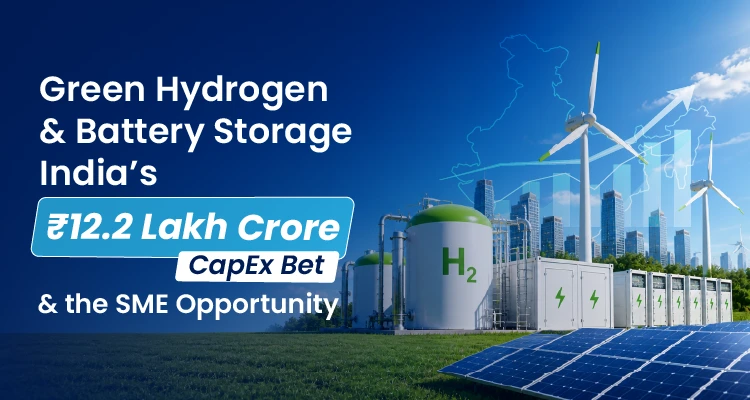
India’s Union Budget 2026-27 sent a clear signal: the country is serious about clean energy, and it’s putting real money behind it. With ₹12.2 lakh crore in capital expenditure committed for the year, green hydrogen and battery storage are no longer ideas on a policy document – they are funded priorities with active procurement cycles already underway.
This creates a specific opportunity for sophisticated investors. India’s SME and microcap sector is quietly becoming the backbone of this clean energy build-out – supplying components, engineering services, and specialized manufacturing that larger players depend on.
At Steptrade Capital, India’s first SME exchange-focused Category II AIF manager, we have been tracking this shift closely across our AIF portfolios. What we are seeing is not a distant promise – it is an active deployment cycle drawing real institutional capital.
Key Takeaways
- Record Capex at ₹12.2 Lakh Crore: Budget 2026-27 sets capital expenditure at a historic high. The Ministry of New and Renewable Energy received ₹32,914 crore – a 30% jump over the prior year – targeting solar, grid storage, and green energy corridors.
- Green Hydrogen Mission Targets 5 MMT by 2030: The National Green Hydrogen Mission, backed by a ₹19,744 crore outlay, aims to produce 5 million metric tonnes of green hydrogen annually by 2030, attracting over ₹8 lakh crore in investments.
- BESS Deployment Pipeline is Live: As of early 2026, 10 GW of battery energy storage systems are under construction in India, with 20 GW under active tendering. The government has committed ₹9,160 crore in Viability Gap Funding across two tranches.
- Budget Cuts Duty Barriers for BESS Manufacturing: Budget 2026-27 extends basic customs duty exemptions to capital goods used for manufacturing lithium-ion cells for BESS – directly lowering the cost of building domestic grid storage production lines.
- SME Supply Chain is the Real Story: Electrolysers, battery enclosures, power electronics, EPC services, and specialized components are largely made by India’s SME sector. Institutional coverage is thin – and that is where the alpha lives.
- SEBI Risk Reminder: SME and microcap stocks carry higher price sensitivity and lower liquidity than large-cap equities. All investment decisions should be based on independent research. Past performance does not guarantee future results.
The ₹12.2 Lakh Crore Capex Context
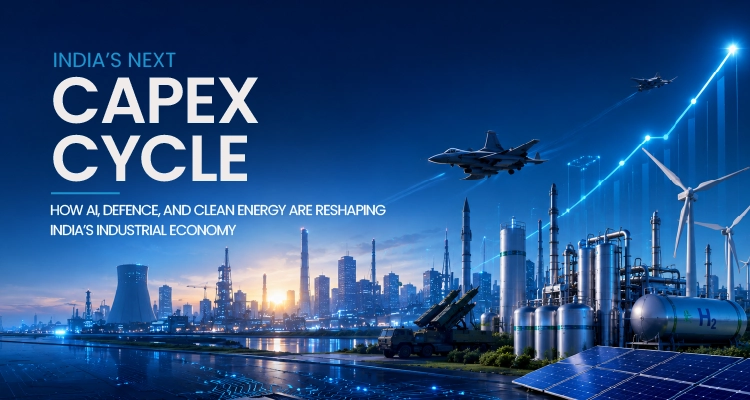
India’s Budget 2026-27 commits ₹12.2 lakh crore in capital expenditure – the highest ever announced by any Indian government. This goes well beyond roads and railways.
The Ministry of New and Renewable Energy received ₹32,914 crore, up 30% from the revised estimate of the previous year. Allocations span flagship programs including PM Surya Ghar, Green Energy Corridors, Viability Gap Funding for battery storage, and the National Green Hydrogen Mission.
The budget also committed ₹20,000 crore over five years toward Carbon Capture, Utilization and Storage (CCUS) across power, steel, cement, and refining sectors. That is not a side note – it is a direct bet on industrial decarbonization requiring specialized equipment and engineering at scale.
For investors tracking where capital is flowing, the 2026-27 budget is unusually clear. Green hydrogen, battery storage, and domestic clean energy manufacturing are priorities – and the tenders are already live to prove it.
Green Hydrogen: India’s Sunrise Sector
The Union Cabinet approved the National Green Hydrogen Mission in January 2023 with a ₹19,744 crore outlay. The goal: produce 5 million metric tonnes of green hydrogen annually by 2030, supported by over ₹8 lakh crore in investments and more than 6 lakh new jobs.
And it is not just targets on paper. As of early 2026, 19 companies have been allocated a cumulative annual production capacity of 8.62 lakh tonnes. Fifteen firms have been awarded 3,000 MW of electrolyser manufacturing capacity under the SIGHT program. These are financial award decisions – not aspirational projections.
The economics work in India’s favour. India has some of the world’s lowest renewable energy costs, which makes the electricity input for electrolysis highly competitive globally. Add to that the government’s waiver of inter-state transmission charges for green hydrogen plants commissioned before December 2030, and the cost structure becomes genuinely attractive.
Demand is also being created actively – through pilot mandates in fertilizers, refineries, steel, and shipping. These are India’s largest fossil fuel consumers. Even partial substitution with green hydrogen represents enormous volume for the supply chain.
For SME investors, that supply chain is broad: pressure vessels, compressors, gas handling systems, heat exchangers, specialized piping, and project engineering. India’s SME manufacturers are already receiving inquiries from Tier 1 green hydrogen developers.
Battery Storage: The Infrastructure India Cannot Build Without
Here is the problem with solar and wind: they do not generate power when it is dark or the air is still. India is adding solar capacity fast – but without storage, that power cannot be used reliably when demand peaks. Battery storage is the missing piece, and the government is now building it at scale.
The Central Electricity Authority estimates India will need 41.65 GW of battery energy storage systems by 2030. To support this, the government approved a ₹3,760 crore Viability Gap Funding scheme in March 2024 for 13,220 MWh of BESS capacity. A second tranche of ₹5,400 crore followed in June 2025 for an additional 30 GWh.
Budget 2026-27 added another tailwind. The basic customs duty exemption on capital goods for lithium-ion cell manufacturing – previously only available for electric vehicles – now covers BESS. This lowers domestic manufacturing costs and encourages gigafactory development within India.
As of February 2026, 10 GW of BESS is under construction across India and 20 GW more is under active tendering. SME manufacturers supplying battery enclosures, thermal management systems, and balance-of-plant components are looking at a genuine multi-year order pipeline.
Where SMEs Fit – The Supply Chain Opportunity
Green hydrogen and battery storage are capital-intensive sectors – but they are not built by a few large companies alone. The infrastructure runs on thousands of components, and a growing share of those are being made by India’s SME sector.
In green hydrogen, the electrolyzer is the core unit. But around it sits pressure regulators, gas storage tanks, compressors, water purification systems, power electronics, and safety enclosures. These fall squarely within the manufacturing capabilities of India’s industrial SME base.
In battery storage, the cell itself is typically imported today. But the enclosure, battery management systems, inverters, thermal management units, civil work, and grid interconnection equipment are increasingly being sourced from domestic manufacturers. That shift is still early – which is exactly where the alpha potential sits.
Steptrade Capital evaluates companies in this supply chain through a specific lens: strong return on equity, visible order book growth, and the ability to scale without excessive capital dilution.
Mission-led government procurement – where agencies issue multi-year tenders to qualified vendors – creates the kind of revenue predictability that builds a compelling SME investment thesis.
What Strategic Investors Should Consider
The opportunity is real. But it comes with complexity that deserves honest attention before capital is deployed.
Execution risk is front and center in both sectors. BESS projects have faced delays from aggressive underbidding in auctions, slow power purchase agreement signings, and grid connection bottlenecks. Green hydrogen offtake is growing but has not yet reached a commercial scale. Companies depending on a single scheme or a single customer carry concentrated risk that must be assessed carefully.
Technology is also moving fast. Battery chemistry, electrolyzer design, and hydrogen production processes are all evolving. SME manufacturers need management teams with real technical depth – not just the capacity to fill today’s orders.
And then there are the inherent SME risks: lower trading volumes, thinner public disclosures, and sharper sensitivity to policy news. These are not reasons to avoid the sector. They are reasons to invest through a research-driven, actively managed structure rather than passive exposure.
All investments in securities are subject to market risk. Past performance does not guarantee future results. Investment decisions should be based on independent research and a clear understanding of personal risk tolerance.
Conclusion
India’s ₹12.2 lakh crore capex commitment is not a headline – it is a structural shift in where the country is going. Green hydrogen and battery storage are funded, tendered, and under construction. The supply chain behind them is where the real investment story is playing out.
For HNIs, UHNIs, and family offices looking at where India’s next wave of alpha is being built, the clean energy SME supply chain deserves a serious look. Institutional coverage is thin. Entry at the right price, in the right companies, backed by the right research – that is how structural transitions get monetized.
Steptrade Capital’s SEBI-regulated AIF structure is built for precisely this kind of exposure – research-driven, SME-focused, and aligned with India’s most significant long-term investment themes. To learn more about how our funds position across India’s clean energy supply chain, visit steptrade.capital.
Frequently Asked Questions
1. What is India’s green hydrogen production target for 2030?
Under the National Green Hydrogen Mission, approved in January 2023 with a ₹19,744 crore outlay, India targets annual production of 5 million metric tonnes of green hydrogen by 2030. The mission is expected to catalyze over ₹8 lakh crore in investments and create more than 6 lakh jobs across the value chain.
2. How much has India committed toward battery energy storage systems?
The government has approved ₹9,160 crore in Viability Gap Funding across two tranches – ₹3,760 crore in March 2024 and ₹5,400 crore in June 2025 – to support 43.2 GWh of battery energy storage capacity. The Central Electricity Authority estimates India will need 41.65 GW of BESS by 2030.
3. What is India’s capex allocation in Budget 2026-27?
India’s Union Budget 2026-27 sets total capital expenditure at ₹12.2 lakh crore, a record high. The Ministry of New and Renewable Energy received ₹32,914 crore – a 30% increase over the prior year – directed at solar, grid storage, green energy corridors, and the National Green Hydrogen Mission.
4. How do SME companies benefit from India’s green hydrogen and battery storage push?
SME manufacturers supply the components behind green hydrogen and battery storage infrastructure – electrolyzer subparts, pressure vessels, battery enclosures, power electronics, and EPC services. Mission-led government procurement creates multi-year order visibility, which translates into revenue predictability for well-positioned companies.
5. What are the main risks of investing in clean energy SMEs in India?
Clean energy SMEs carry inherent risks: lower liquidity, thinner public disclosures, and sharper sensitivity to policy and execution of shifts. BESS deployments have also faced delays from underbidding and slow power purchase agreement signings. All investments are subject to market risk, and past performance does not guarantee future results.
6. Why is battery storage essential for India’s 500 GW renewable target?
India’s 2030 target of 500 GW of non-fossil fuel capacity relies on variable solar and wind generation. Without storage, grid stability drops during non-solar hours. Battery storage absorbs surplus solar power during the day and dispatches during evening peak demand – making renewable energy reliable and commercially viable at grid scale.
Read More:
- SEBI’s New AIF Reporting Framework From Quarterly Reports to Annual Activity Reports
- AIF vs PMS vs Mutual Fund vs SIF: A Complete Comparison Guide for 2026
- How Alternative Investment Funds Fuel Pre-IPO Growth and Fundraising in Indian Markets
- Evolution of Alternative Investment Funds in GIFT City (IFSC)
- Beyond Mutual Funds: How Alternative Investment Funds Unlock India’s Private Markets and Higher Returns