







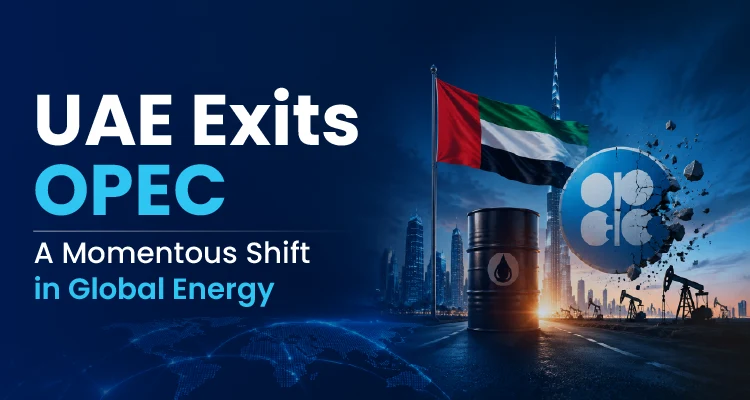
The Organisation of the Petroleum Exporting Countries (OPEC) is an international organisation comprising leading oil-producing states that cooperate to develop common strategies for petroleum, set global oil prices, and maximise economic gains.
In its decision to withdraw from the OPEC starting May 1, 2026, the United Arab Emirates may have created what could turn out to be one of the most impactful changes in the geopolitical dynamics of the global energy market since Qatar pulled out of the cartel in 2019, but on a far larger scale.
Whereas Qatar and Angola had been relatively minor players when they withdrew from OPEC in 2019 and 2023, respectively, the UAE produces about 12% of OPEC crude oil output, possesses considerable spare capacity, and stands out among other producers for its ongoing investment in increasing production.
The UAE has indicated that pulling out of these alliances is due to its “evolving energy profile” and increased output, all while playing a “responsible and reliable role” in international markets.
However, beneath this statement exists the possibility of major changes in the availability and pricing of oil.
Why the UAE Walked Away
The main issue behind this exit is the increasing misalignment between the discipline of OPEC and the economic considerations of the UAE.
Over the years, Abu Dhabi has spent millions of dollars through ADNOC to increase its crude oil production capacity. However, due to the OPEC quota, the amount of oil produced by the UAE remains at a certain level:
- Current production: ~3.4 million barrels/day
- Production capacity: ~4.8 million barrels/day
- Targeted capacity: 5 million barrels per day by 2027
This created a clear economic contradiction:
High sunk capital + low marginal cost + artificial output cap = lost revenue
Challenge or Gain?
For the near future, this will cause uncertainty. The Organisation of Petroleum Exporting Countries (OPEC) has been having some internal struggles, from Angola leaving in 2023 to disagreements on the quotas. The United Arab Emirates’ decision to leave OPEC will make things worse and cause instability through:
- Reduced confidence in quota discipline
- Oil price fluctuations
- Trouble with OPEC+ unity
- A change in production plans from Saudi Arabia
That is the challenge.
But the Long-Term Effects May Be More Positive
For importers like India, and arguably for the global market, the long-term implications may be constructive.
The UAE, free from quota restrictions, can produce more independently.
That could lead to:
- Additional supply entering global markets
- Moderation of cartel pricing power
- Greater competition among producers
- Improved supply security for Asian importers
In effect, what seems disruptive now may be efficient in the future.
A Larger Shift Underway?
The greater importance may lie in the fact that this is not just an OPEC story.
It might be indicative of a shift in international energy politics – from collective producer management to a more fragmented and nation-focused approach.
Old model:
- Collective supply management
- Saudi-led stabilization
- Price defence through quotas
Emerging model:
- Producer nationalism
- Market share competition
- Affordability of strategic independence from cartel enforcement
For India, this is a trend to be noted closely, not just as an oil narrative but as a shift in the geopolitics of energy.