








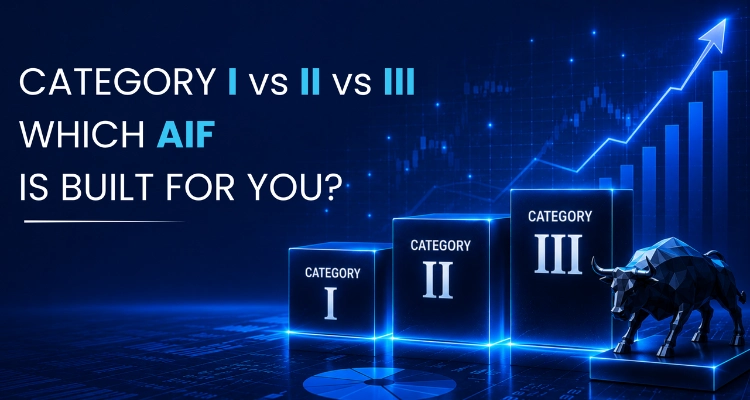
A founder who has recently monetised equity, a legacy family office preserving generational wealth, and an aggressive HNI seeking tactical alpha have very different relationships with capital. Different time horizons. Different liquidity needs. Different risk appetites.
They should not be allocating through the same structure.
And that is precisely why SEBI created three distinct AIF categories. Understanding which one is built for your profile is an important wealth strategy.
Category 1- Early Stage, Long Game
Category I AIFs invest in venture capital, angel funds, infrastructure, and social venture funds. The defining characteristic of this category is that capital goes in early before institutional maturity, before scale, and often before predictable cash flows.
What you are investing in:
- Venture Capital & Angel Funds — Early-stage bets before institutional valuations arrive. Think companies at their Series A or B — the Indian equivalent of backing Zepto or Razorpay before they became names everyone recognised
- Infrastructure Investment Funds — Solar energy parks, highway projects, port assets. Long-gestation, but with relatively predictable cash flows once operational.
- Social Venture Funds — Businesses solving scale problems in healthcare, agri-tech, affordable housing, and financial inclusion — with real return expectations alongside developmental intent.
The structural realities:
- Investment horizon: typically, 7–10 years
- Liquidity: low to very low — exits depend on IPOs, acquisitions, or secondary sales
- Return profile: asymmetric — a few large winners drive the portfolio
- Tax treatment: pass-through taxation — gains are taxed in the hands of the investor, not the fund
- SEBI provides regulatory concessions to Category I funds given their positive economic and social impact
Who belongs here:
Category I suits investors who understand operating risk and are comfortable with illiquidity in exchange for the potential of exponential value creation. Entrepreneurial families and next-generation wealth creators often find this category most aligned with how they think about capital — as a tool for building something, not just compounding something.
First-generation wealth creators, in particular, tend to be more comfortable here. They have built businesses, they understand early-stage risk, and they are not dependent on this capital for near-term liquidity.
This is your category if: you have long-duration capital you do not need back for 7–10 years, you understand business-building risk, and you want exposure to companies before institutional capital arrives.
Category 2- Private Markets. Institutional Process. Where Most Smart Money Sits.
Category II is the largest AIF category in India by capital commitments — and for good reason. It includes private equity funds, debt funds, real estate funds, and fund of funds. This is where the majority of sophisticated Indian private capital is deployed today.
The appeal of Category II lies in its balance: access to private markets with institutional governance, meaningful return potential without purely speculative positioning, and structured deployment with defined exit visibility.
What you are investing in:
- Private equity — growth-stage and mature unlisted companies
- Pre-IPO Opportunities — Companies in the 12–36-month window before listing. Investors who entered companies like Nykaa, Delhivery, or Ola Electric at the pre-IPO stage through Category II vehicles captured meaningful upside before public markets priced them in.
- Private credit and structured debt — yield-oriented with defined repayment
- Real Estate Funds & Fund of Funds — Exposure to commercial real estate projects or diversified baskets of other AIF strategies through a single structured vehicle.
The structural realities:
- Investment horizon: typically, 4–7 years
- Liquidity: low during the fund tenure, with exits at defined milestones
- Return profile: moderate-to-high, driven by business growth and exit multiples
- Tax treatment: pass-through taxation — the fund itself is not taxed; gains flow directly to investors
- Capital is often deployed in tranches via a drawdown structure, not upfront in one shot
Who belongs here:
Category II suits mature HNIs, business families, and structured family offices who want private market exposure with institutional process around deployment, governance, and exits. These are investors who think in allocation frameworks rather than individual bets.
As Indian wealth matures, more HNIs are gravitating toward Category II not because it promises the highest returns, but because it aligns most closely with how mature wealth prefers to behave — structured, process-driven, and compounding over time.
It is also the preferred route for investors who want access to pre-IPO opportunities with the discipline of a defined investment mandate rather than ad hoc deal flow.
This is your category if: you can lock in capital for 4–7 years, you want exposure to private markets with institutional governance, and you prefer structured compounding over speculative positioning.
Category 3- Market-Linked. Shorter Cycles. Higher Activity.
Category III is where capital stays closest to the market. Unlike Categories I and II where money is locked into businesses for years, Category III funds — hedge funds, PIPE funds, and long-short funds — operate in shorter cycles, responding to market conditions, pricing inefficiencies, and live opportunities. The mandate here is not to hold and wait. It is to actively generate returns across different market environments.
What you are investing in:
- Public equities via long-short and market-neutral strategies
- PIPE transactions — Private Investment in Public Equity. Buying into listed companies at a negotiated discount to market price — typically during a fundraise or restructuring. The discount itself is the margin of safety.
- Derivatives, arbitrage, and event-driven strategies
- Tactical Sector or Thematic Positioning — Concentrated, time-bound bets on sectors experiencing structural tailwinds or temporary dislocations — defence, PSU banks, or specialty chemicals at the right point in the cycle.
The structural realities:
- Lock-in: shorter or no lock-in depending on the strategy
- Liquidity: relatively higher compared to Category I and II
- Return profile: high-risk, alpha-seeking — performance is more volatile and strategy-dependent
- Tax treatment: Category III funds are taxed at the fund level, not pass-through — this is a meaningful cost difference versus Category I and II that investors often overlook
- Leverage is permitted in Category III, which amplifies both upside and downside
Who belongs here:
Category III suits experienced HNIs who are active market participants, understand trading strategies, and are liquidity-conscious. This is not a set-and-forget allocation — it requires closer monitoring and a clear understanding of the strategy being deployed.
It also suits investors who want a liquid, actively managed sleeve within a larger portfolio — capital that can be deployed and redeemed without the multi-year commitment that Categories I and II require.
This is your category if: you want shorter lock-ins, understand active market strategies, have a higher risk tolerance, and are comfortable with fund-level taxation in exchange for greater liquidity.
Which one is built for you?
The answer depends on four things: your time horizon, your liquidity requirement, your risk appetite, and your tax sensitivity. Here is a direct framework:
- You are a first-generation wealth creator or entrepreneurial family with long-duration surplus capital
Category I. You understand operating risk, you do not need this capital back for a decade, and the asymmetric return potential of early-stage exposure aligns with how you think about wealth creation.
- You are a mature HNI, business family, or family office seeking structured private market exposure
Category II. You want institutional governance, defined exit visibility, pass-through tax efficiency, and the ability to access pre-IPO and private equity opportunities within a disciplined framework.
- You are an active, experienced investor who prioritises liquidity and tactical alpha
Category III. You are comfortable with market-linked strategies, shorter cycles, and fund-level taxation, and you want a dynamic allocation that can be adjusted as market conditions change.
Most sophisticated HNIs do not sit in just one category. A well-constructed portfolio often has a core allocation in Category II for compounding, a smaller tactical sleeve in Category III for alpha, and selective Category I exposure for transformational upside. The proportions depend on your wealth stage, liquidity needs, and how much illiquidity you can genuinely afford to hold.
If you are beginning your AIF journey and are uncertain where to start, my personal recommendation is Category II. It sits at the intersection of private market access, institutional process, and tax efficiency — giving you meaningful exposure to how sophisticated capital works without the extreme illiquidity of Category I or the active monitoring that Category III demands. It is the most forgiving entry point, and for most HNIs, it is where the AIF investing journey finds its footing.
Once you have lived through a Category II fund cycle — understood drawdowns, NAV movements, exit timelines, and portfolio construction — you will have the experience and conviction to layer in Category I for transformational upside and Category III for tactical alpha.
The question is never which category has the best returns. The question is which category is structurally aligned with your capital, your timeline, and your wealth goals. Investing through the wrong structure — even with the right manager — creates friction that compounds against you over time.
Note: Views are educational in nature and does not constitute investment advice.
Read More:
- AIOF, CIV, LVF – SEBI’s Three New AIF Structures and Who They Are For
- SEBI’s New AIF Reporting Framework From Quarterly Reports to Annual Activity Reports
- Income Tax Act 2026 Is Live: AIF Investor Checklist for Tax Year 2026-27
- SEBI’s New AIF Exit Rules (March 2026): What Investors Must Know Before Their Fund Closes
- New Income Tax Act 2025 and Its Impact on AIF’s Investors in India