







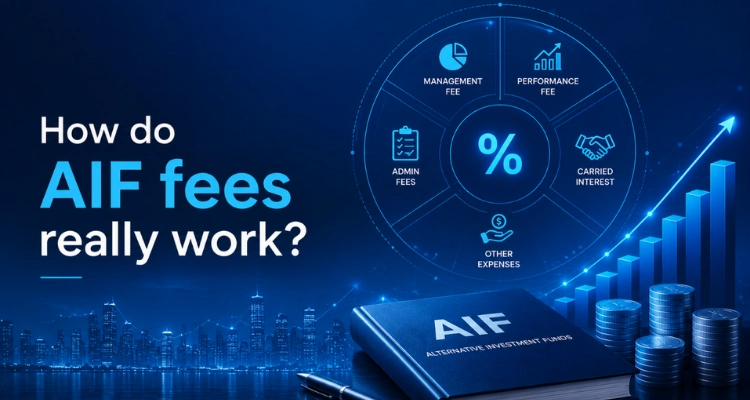
The fee structure of an AIF is one of the most overlooked features. Very few spend enough time understanding the fee structure.
Two funds targeting the same return can produce very different outcomes for investors simply because of how fees are structured.
AIF fees are not necessarily excessive. In fact, many are designed to align the interests of fund managers and investors. But they are often misunderstood.
It is important to understand precisely how the economics work before you start investing ₹1 crore or more in an AIF.
The Four Components of AIF Fees
Most AIFs charge a combination of the following — not every fund charges all four, and the mix itself tells you something about how the manager is incentivised.
1. Management Fees — Recurring, charged regardless of fund performance.
2. Operating Expenses — Pass-through costs for running the fund day to day.
3. Performance Fees — Variable, earned only when the fund outperforms a benchmark.
4. One-Time Charges — Charged at specific events: onboarding, formation, or exit.
1. Management Fees
Management fees are recurring costs incurred by the Investment Manager of an AIF from the corpus or drawn-down committed capital of the fund as payment for management services, fund administration services, investor servicing, and overall operational supervision. Unlike performance-linked fees, the management fee is charged regardless of whether the fund generates profits.
| Basis | What It Means | Common Usage |
| Committed Capital | Fee is charged on the total amount investors commit, even if all the money has not yet been invested. | Common in Category II AIFs (Private Equity and Debt Funds). |
| Drawn Down / Invested Capital | Fee is charged only on the amount that has actually been invested. | Used by funds that align fees with the pace of investments. |
| Net Asset Value (NAV) | Fee is charged as a percentage of the fund’s current market value (NAV). | Common in Category III AIFs, including hedge funds and long/short strategies. |
| Corpus | Fee is charged on the total value of the fund corpus. | Used by certain AIFs during the investment period. |
Fee Range:
CAT I- 1% – 2%
CAT II- 1% – 2.5%
CAT III- 1% – 2%
These figures are negotiated at the time of fund documentation and disclosed transparently in the PPM.
SEBI’s framework for Management Fees:
- Management fees must be disclosed in the PPM — the amount, method, and frequency of charge.
- The management fee is not capped by SEBI for any category of AIF, except Angel Funds (Category I AIFs). In all cases, this is left open to business negotiations between the manager and investors.
- As per SEBI’s April 2023 circular, if an AIF offers direct plan, then the management fee charged under the direct plan should be less than the one charged under the distributor plan/regular plan.
2. Operating Expenses
Operating expenses are the fund-level costs incurred in the day-to-day administration, compliance, and maintenance of an Alternative Investment Fund, distinct from the management fee paid to the Investment Manager.These expenses are normally passed through costs since they are incurred by the fund itself and therefore by investors on a pro-rata basis.
What’s included?
- Legal Costs
- Audit & Accounting fees
- Custodian fees
- Registrar & Transfer Agent (RTA) fees
- Trustee fees
- Compliance & Regulatory filing costs
- Valuation fees
- Insurance
- Incidental and Miscellaneous expenses
Practical tip: ask for the total expense load — management fee plus operating expenses combined. This gives a far more accurate picture of your real cost of investing than the management fee figure alone.
SEBI does not prescribe a cap on operating expenses for most AIF categories, but requires that:
- All operating expense heads must be disclosed in the PPM with clarity on whether they are capped or uncapped.
- Operating expenses need to be reasonable and incurred in the normal course of business.
- The operating expenses related to any affiliate company should be disclosed to the investor committee or advisory committee.
3. Performance Fees
The performance fees, known as carried interest or carry, are the variable remuneration paid to the Investment Manager depending on the fund generating performance over a certain set benchmark. In contrast to the management fee, performance fees are not charged regularly but earned when overperformance is achieved.
How does it work?
- Hurdle Rate – The minimum annual rate of return that should be earned for the investors prior to earning any carry for the manager. Hurdle rates of 8-12% per year are common in Indian AIFs.
- Carry Percentage – The percentage of the profits that are earned above the hurdle that goes to the manager. 20% of profits after the hurdle is the industry standard, though some managers may charge between 10-25%
What is The Waterfall Structure?
The waterfall structure is the sequence in which profits generated by an AIF are distributed between investors and the fund manager.
Return of Capital: Investors will get the full amount of the capital contribution back before they can enjoy any returns on their investment. At this point, there are no performance fees payable.
Preferred Return: Once capital is returned, investors will get the preferred return on their capital, normally 8%-12% per annum on an annual compounding basis, for the time during which their capital has been committed. That is the hurdle rate concept. The manager does not get any carried interest until the hurdle rate has been met fully.
Catch-up: Once investors receive the hurdle rate, a larger share of subsequent profits temporarily accrues to the fund manager until the agreed-upon carried interest percentage is achieved. Not all Indian AIFs use this structure, but it is common in private equity globally.
Without a Catch-up Clause: Many Indian AIFs do not have a catch-up clause at all. In this structure, once the fund crosses the hurdle, the manager only earns carry on the profit generated above the hurdle — not on the entire return. This is meaningfully more investor-friendly: the investor keeps 100% of the hurdle return, and only shares the excess upside with the manager. Always check whether your fund’s PPM has a catch-up clause or not — it directly changes how much of your outperformance you actually keep.
Profit Split: The rest of the profit gets split among the investors and the fund manager based on the predetermined carry ratio (80% to investors/20% to manager).
SEBI’s framework for Performance fees:
- The structure of performance fee must be clearly stated in the PPM – Percentage, hurdle rate, how calculated, and waterfall.
- There is no limit on carry for CAT I, II and III AIFs by SEBI; it can be commercially negotiated.
- As per the April 2023 direct plan circular, performance fee arrangements in direct plans must be separately disclosed and should not be in any way biased against direct plan holders versus regular plan holders.
4. One-time charges
One-time charges are charged periodically within the fund life cycle and predominantly at the time when investors come on board, the fund is created, or the fund is exited. These fees are outlined in the PPM and make up the total cost framework investors have to consider.
Formation Fees: Charged to cover the costs of establishing the fund, like drafting of the PPM, Contribution Agreement, Trust Deed, SEBI registration fees, stamp duties, and initial structuring costs.
- May be charged to the fund (borne by all investors pro-rata) or to early investors.
- Sometimes absorbed by the management and assigned to the fund at a later stage.
Upfront/ Commitment Fees: Charged at the time an investor signs the Contribution Agreement and commits capital to the fund. Compensates the manager for onboarding, KYC processing and legal review.
- Usually ranges from 0% to 1% of committed capital.
- Can be waived for anchor investors or large-ticket commitments.
- Distinct from the management fee, generally charged only once.
Drawdown/ Contribution Fees: In some fund structures, a small fee is charged each time capital is called down from investors during the investment period. This is more operational in nature and compensates for transaction processing, banking, and allocation costs per drawdown event.
- Less common in Indian AIFs
SEBI’s framework for One-time charges:
- All one-time charges must be disclosed in the PPM with their quantum, basis, and the party bearing the cost.
- SEBI does not prescribe caps on most one-time charges; they can be commercially negotiated.
Why Fee Structure Analysis Is Non-Negotiable Before Investing in an AIF?
For an HNI or UHNI investor, the fee structure of an AIF is not an administrative detail; it is a direct determinant of net returns. Every rupee paid in fees is a rupee subtracted from compounded wealth creation. Over a 5–7 year fund lifecycle, the cumulative drag of a poorly understood fee structure can be substantial.
Before signing a Contribution Agreement, an informed investor should ask:
- What is the management fee, and is it on committed or drawn-down capital?
- What are the estimated operating expenses, and are they capped?
- What is the hurdle rate — and is it a hard or soft hurdle?
- Is the waterfall whole-fund or deal-by-deal?
- Is there a catch-up clause, and at what percentage?
- Are there one-time charges?
- Is a direct plan available, and what is the cost differential?
Hence, the fee structure in AIFs is complicated, multi-layered and significant. It is not consistent across all AIFs, so the PPMs need to be evaluated on their own merits. For an investor investing at least Rs. 1 crore in an illiquid and long-term vehicle, the difference between a good and bad fee structure is not trivial, but a difference of a few percentage points in IRR, compounding over years.
Read More:
- SEBI’s New AIF Reporting Framework From Quarterly Reports to Annual Activity Reports
- AIF vs PMS vs Mutual Fund vs SIF: A Complete Comparison Guide for 2026
- How Alternative Investment Funds Fuel Pre-IPO Growth and Fundraising in Indian Markets
- Evolution of Alternative Investment Funds in GIFT City (IFSC)
- Beyond Mutual Funds: How Alternative Investment Funds Unlock India’s Private Markets and Higher Returns