









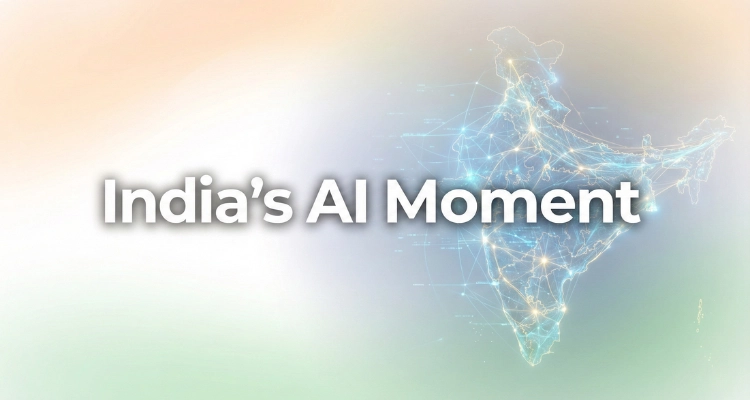
With 300+ exhibitors from over 30 countries, India is currently hosting its first-ever large-scale AI summit, the India AI Impact Summit 2026, drawing global attention to the potential that a developing economy can unlock through artificial intelligence.
The Summit positions India not merely as an adopter of AI, but as a shaper of how AI can drive economic growth, sustainability, and human progress at scale. The forum reflects a powerful idea: AI is not about replacing humans; it is about enabling people to work smarter, faster, and more efficiently, while solving problems that were once considered too complex or resource-intensive.
India + AI- a Rising Global AI Leader
- The NASSCOM AI Adoption Index reports that 87% of Indian enterprises are actively using AI solutions across sectors, including BFSI, healthcare, retail, and manufacturing.
- Rather than eliminating jobs, AI is reshaping employment — generating demand for data engineers, AI trainers, domain experts, and system integrators, while improving hiring efficiency and workforce productivity
- AI is projected to add over $500 billion to India’s GDP by 2035, driven by productivity gains, automation, and data-led decision-making.
The Core Mission
People: India produces millions of graduates every year, yet only a fraction are currently AI-ready. The Summit highlighted:
- Large-scale AI skilling programs for students, professionals, MSMEs, and government officials
- Plans to integrate AI more deeply into public administration and citizen services
Hence, to make the citizens literate enough to access the tech.
Planet: AI is being positioned as a critical tool to address India’s environmental challenges:
- Flood, cyclone, and heatwave forecasting using AI-driven climate models
- Agriculture support through crop yield prediction, soil health analysis, and water optimisation
- Smarter energy management through AI-enabled grids
This will help save lives, reduce economic losses and improve agro-based incomes.
Progress: Progress cannot be defined by speed, but sustainability.
- AI-powered research labs will reduce dependence on foreign infra and research reports.
- Focus on safe, accountable, and responsible AI deployment
This suggests that funding alone won’t help; the hunger to deploy AI into routine systems is necessary.
The Backstage Scenario
AI summits, policy announcements, and vision decks present a confident picture of India’s technological development. However, beyond conference halls and boardrooms, India’s dynamics are far more layered.
- Digital access does not always translate into digital usability
The high cost of advanced AI machinery and software makes widespread adoption in agriculture a long-term journey, particularly for farmers facing financial constraints.
- Execution gaps remain significantMSMEs form the backbone of India’s economy, but many lack capital, trained personnel and data readiness to effectively implement AI systems.
- Structural challenges persist
AI, by itself, cannot correct structural challenges such as weak education systems, governance inefficiencies, lack of process discipline, or poor data integrity, as they require long-term structural planning rather than tech support.
The India AI Impact Summit 2026 marks an important and affirmative start to India’s AI journey. While challenges are real, recognising them early can be the sign of preparedness. AI may not solve these issues overnight, but when combined with long-term policy consistency, institutional reform, and inclusive execution, it can become a powerful enabler of sustainable growth. The true impact of this Summit will be measured not by announcements, but by how effectively its vision translates into everyday systems, turning today’s hurdles into tomorrow’s foundations for progress.