







Introduction
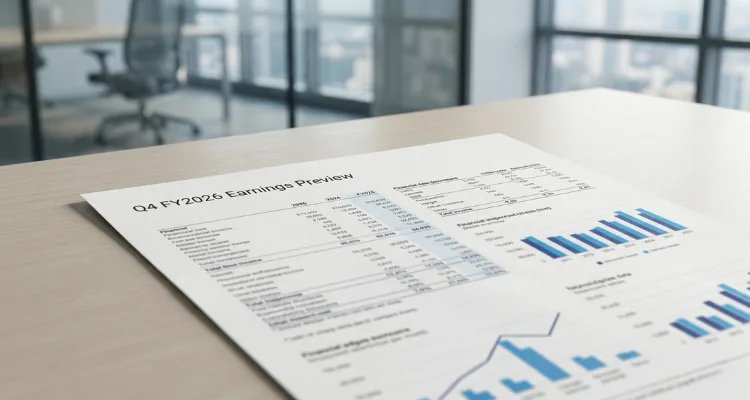
Results season for Q4 FY2026 begins in April 2026. For SME and microcap investors, this quarter carries more weight than most.
India’s MSMEs contribute 31.1% to GDP, 35.4% to manufacturing output, and 48.58% to exports, per the Economic Survey 2025-26. That makes their earnings a direct read on the health of the real economy.
The full-year macro picture is strong. What matters now is whether smaller companies have translated that into actual revenue and margin improvement – and which sectors lead the way.
Key Takeaways
- India’s GDP: Real GDP grew 7.8% in Q3 FY2026 and is estimated at 7.6% for the full year, per MoSPI’s Second Advance Estimates (Feb 27, 2026).
- Manufacturing strength: Manufacturing posted double-digit GVA growth for the fifth consecutive quarter in Q3 – a strong signal for industrial SMEs.
- SME IPO activity: 217 SMEs listed in FY2026 up to December 2025, raising ₹9,635 crore – up from 190 listings and ₹7,453 crore a year earlier.
- PLI tailwind: PLI schemes across 14 sectors attracted over ₹2 lakh crore in investment and generated ₹18.7 lakh crore in incremental production/sales.
- Sectors to watch: Capital goods, specialty chemicals, logistics, healthcare, and agri-inputs are well positioned for Q4 earnings strength.
- SEBI reminder: SME and microcap stocks carry higher risk than large caps. Past performance does not indicate future results. Conduct thorough due diligence before investing.
The Macro Backdrop Heading into Q4
India’s economy delivered 7.8% real GDP growth in Q3 FY2026, led by services reaching a seven-quarter high of 9.5% and manufacturing growing in double digits for the fifth straight quarter, per MoSPI.
Q4 growth is projected to ease to around 7.3% – a natural moderation given the high base, not a sign of weakness. Domestic consumption remains the anchor, supported by low inflation and the transmission of three repo rate cuts totaling 75 basis points.
For SMEs, this is a favorable environment. Lower borrowing costs ease working capital pressure. A stronger rural economy lifts end-market demand. GST rationalization has improved cash flows across supply chains.
PLI Schemes and Capex: Structural Lift for SME Earnings
The Production Linked Incentive (PLI) scheme has been a direct earnings driver for a wide range of SMEs. Across 14 sectors, PLI has attracted over ₹2 lakh crore in actual investment, generating over ₹18.7 lakh crore in incremental production/sales and 12.6 lakh jobs as of September 2025, per the Economic Survey.
SMEs supplying components, packaging, logistics, and tooling to PLI-linked anchor companies have seen order volumes rise steadily. Q4 results from this sub-segment are expected to reflect that sustained demand.
Government capital expenditure, which reached nearly 60% of the budgeted allocation by November 2025, has similarly supported order books of engineering and construction-linked SMEs through Q4.
Sector-by-Sector Earnings Outlook
- Capital Goods and Engineering: Order books remain healthy. Execution momentum built through the year is expected to translate into strong Q4 revenue numbers for listed engineering SMEs.
- Specialty Chemicals: Pricing has stabilised after two years of pressure. Volume recovery is underway. Q4 may mark the beginning of a margin expansion cycle for mid-sized chemical companies.
- Logistics and Warehousing: The January-March quarter typically sees high volumes linked to consumer goods restocking. SMEs in third-party logistics and cold chain are well positioned.
- Healthcare and Diagnostics: Mid-sized hospital chains and pathology networks have delivered steady growth all year. Q4 results are unlikely to disappoint in this space.
- Agri-Inputs and Rural FMCG: A favorable kharif harvest and strong rabi sowing have lifted rural incomes. Companies serving the rural end-market should report solid Q4 top-line growth.
SME IPO Activity Signals Broader Confidence
The number of SME listings in FY2026 (up to December 2025) rose to 217 from 190 in the prior year period, with the amount raised climbing from ₹7,453 crore to ₹9,635 crore, per the Economic Survey 2025-26.
A larger listed universe means more earnings data, better analyst coverage, and improved price discovery. That is positive for the segment’s long-term investment quality.
A dense IPO calendar in Q4 can temporarily redirect attention and capital from secondary market SME stocks. This creates short-term noise but does not change the underlying earnings story.
The Iran-US Conflict: A Risk SME Investors Must Watch
The US-Israel military strikes on Iran, which began on February 28, 2026, have introduced a significant external risk into an otherwise strong Q4 earnings setup. The conflict has disrupted the Strait of Hormuz – through which approximately 20% of global oil and one-fifth of global LNG shipments transit, per Chatham House – sending Brent crude up over 15% in the opening days.
India imports nearly 85% of its crude oil, making it directly exposed. Indian equity markets fell approximately 4% within two days, the INR breached 92/USD, and foreign capital outflows from Indian equities exceeded ₹25,000 crore in March 2026, per ICICIDirect.
The sectoral impact on SMEs is uneven. Paints, chemicals, and polymers face immediate raw material cost pressure. Logistics SMEs absorb higher diesel and freight costs. Agri-exporters with Middle East exposure are particularly hit – over 400,000 metric tons of basmati rice shipments were stuck at Indian ports due to shipping lane disruptions, per CNN.
The conflict draws a clear line between SMEs with crude or Middle East export exposure, and those anchored to domestic demand – a distinction that matters as much as sector in evaluating Q4 results.
How to Read Q4 Results
Before reading Q4 numbers, check out two things: crude oil exposure and Middle East export dependency. These two factors now separate companies that can deliver on expectations from those that cannot – regardless of sector.
Beyond that, focus on cash flow and working capital – not just revenue. In small and microcap stocks, these numbers often tell a more honest story than the headline profit figure. Valuations in this space have risen sharply over the past two years, and any earnings miss can lead to a fast, steep correction given how thinly traded many of these stocks are.
What management says after results matters more than the numbers themselves. The order pipeline, demand outlook, and guidance for the next quarter are the real signals to track.
SME and microcap stocks carry higher risk than large-cap equities – lower trading volumes, less public information, and sharper price swings. Every investment decision should be based on independent research and a clear understanding of personal risk tolerance.
Conclusion
Q4 FY2026 arrives on the back of India’s strongest sustained manufacturing growth in years. The conditions – robust domestic demand, lower borrowing costs, and policy-driven order flow – favour well-run, domestic-facing SMEs and microcaps.
Selectivity is the key discipline. Not every company in this space will benefit equally. Sector positioning, balance sheet discipline, and management execution quality remain the separating factors.
At Steptrade Capital, the focus remains on identifying structurally sound SME and microcap opportunities through rigorous, bottom-up analysis. Reach out to Steptrade Capital to explore how this segment can fit within a disciplined long-term investment framework.