








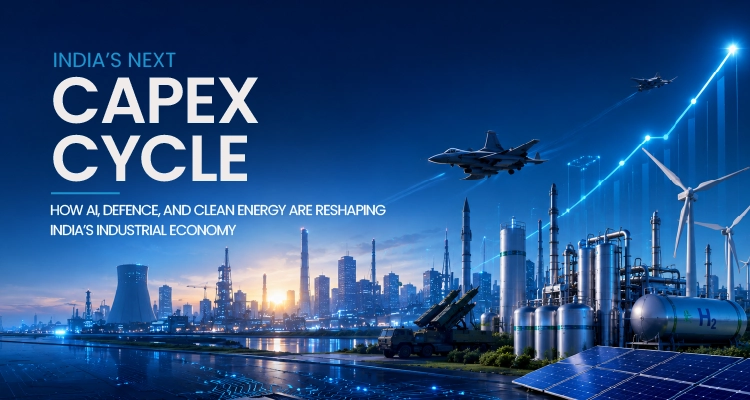
India may be entering one of its broadest industrial and manufacturing cycles in decades.
What makes this phase different is that it is not being driven by a single sector alone. Artificial Intelligence (AI), defence manufacturing, and the clean energy transition are all scaling simultaneously and together, they are beginning to reshape how capital gets deployed across infrastructure, manufacturing, industrial supply chains, and technology ecosystems.
Historically, some of the biggest wealth-creation cycles emerge when multiple structural themes start reinforcing each other at the same time. That is what makes the current environment particularly interesting.
This may not simply be another sectoral rally. It could be the beginning of a much larger industrial expansion cycle for India.
AI Is Becoming an Infrastructure Story
Most conversations around AI focus on software, automation, and digital platforms
But beneath the surface, AI is also becoming a large infrastructure and manufacturing opportunity.
India’s data centre capacity is expected to nearly triple to around ~4 GW by 2030, driven by AI workloads, cloud expansion, enterprise digitisation, and rising digital consumption.
What often gets ignored is the physical infrastructure required to support this growth.
Data centres are highly power-intensive assets. As AI adoption expands, demand is gradually rising for transmission infrastructure, cooling systems, backup power solutions, grid balancing equipment, electrical systems, and industrial automation. In many ways, the growth of AI is also creating a parallel industrial and engineering opportunity underneath the technology layer itself.
This means the long-term beneficiaries of AI may not remain limited to software companies alone. Industrial manufacturers, infrastructure companies, engineering businesses, and specialised suppliers could also become important participants in this cycle.
Defence Manufacturing Is Moving into a New Phase
India’s defence manufacturing ecosystem is also entering a structurally different stage of growth.
The FY26 defence allocation stands at approximately ~₹7.85 lakh crore, while domestic defence production has already crossed ~₹1.39 lakh crore. More importantly, nearly 75% of defence capital procurement is now reserved for Indian suppliers.
The scale of localisation taking place here is significant.
What becomes interesting is that the opportunity is gradually moving deeper into the broader supply chain ecosystem rather than remaining concentrated only among large defence companies.
Demand is increasingly expanding across:
- Precision engineering
- Aerospace components
- Electronics manufacturing
- Advanced materials
- Drone systems
- Industrial testing and specialised components
Defence manufacturing also creates relatively longer execution visibility. Procurement cycles are often multi-year, qualification timelines are lengthy, and switching costs remain high which can create a more stable demand environment for specialised industrial businesses and engineering-led SMEs.
Clean Energy Is Becoming a Manufacturing Opportunity
India’s clean energy transition is now evolving into something much larger than just EV adoption or renewable capacity additions.
The ecosystem underneath is expanding rapidly.
India’s annual battery demand could reach approximately ~210 GWh to ~260 GWh by 2030. At the same time, battery storage targets could touch ~47 GW by 2032, reflecting how quickly the country’s energy infrastructure requirements are scaling.
As renewable energy capacity continues to scale, the focus is gradually shifting toward the infrastructure and industrial systems required to support it. Demand is rising across battery storage systems, grid modernisation, power electronics, thermal management, energy management systems, speciality materials, and industrial engineering, all of which are becoming essential for building a scalable and reliable clean energy ecosystem.
Historically, large industrial opportunities rarely create value only at the end-product level. Over time, value creation often shifts deeper into the supporting ecosystem as supply chains mature, capacities expand, and manufacturing capabilities strengthen.
Where These Sectors Begin to Overlap
The most important part of this cycle is how interconnected these themes are becoming.
AI infrastructure requires power systems and cooling infrastructure.
Clean energy requires storage systems, electronics, transmission infrastructure, and grid solutions.
Defence manufacturing depends on semiconductors, advanced materials, precision engineering, and industrial capability.
Which means the opportunity is gradually moving deeper into the industrial ecosystem itself.
This includes:
- Electrical equipment manufacturers
- Industrial automation companies
- Precision manufacturing businesses
- Thermal management solution providers
- Power electronics manufacturers
- Engineering-led SMEs
- Speciality material companies
These businesses may not always be the most visible names in the market, but they often become critical enablers during large-scale manufacturing and capex cycles.
India May Be Entering a New Industrial Expansion Cycle
India’s current capex cycle appears structurally different from previous ones because it is being driven simultaneously by:
- AI infrastructure expansion
- Defence indigenisation
- Manufacturing localisation
- Clean energy investments
- Grid and storage infrastructure
- Public and private capex
That kind of overlap is relatively rare.
And it could create opportunities not only in the sectors making headlines today, but also in the industrial backbone quietly getting built underneath them.
Over the next decade, some of India’s most important long-term opportunities may emerge from companies enabling the country’s industrial transformation – businesses involved in engineering, manufacturing, industrial systems, and specialised supply chains that form the foundation of this next phase of growth.