







Introduction
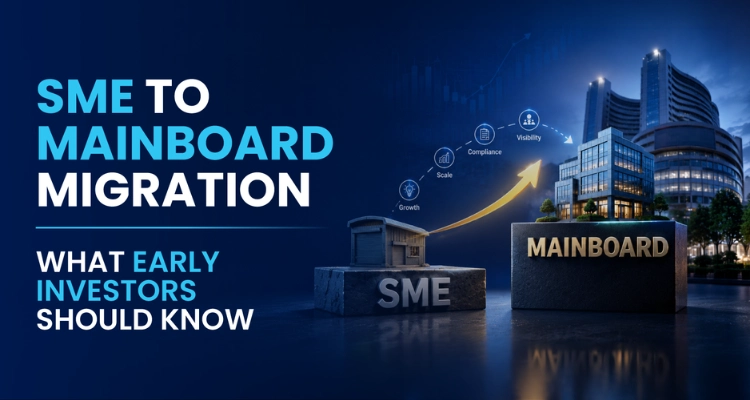
When a company migrates from India’s SME exchange to the mainboard, it is not just changing where its shares trade. It is graduating into a different tier of the Indian capital market – one with stricter governance, broader institutional visibility, and a fundamentally different liquidity profile.
For early investors, this is both an opportunity and a decision point. Valuation dynamics shift, compliance obligations expand, the shareholder base broadens. And the investment thesis that made sense on the SME exchange often needs re-examining with fresh eyes.
At Steptrade Capital – India’s first SME exchange-focused, SEBI-registered Category II AIF emanager – migration events are among the most carefully watched developments in portfolio monitoring. This blog covers what migration means, what SEBI and the exchanges now require, and what early investors need to understand before and after the shift.
Key Takeaways
- 160 Companies Have Migrated from NSE Emerge, 201 From BSE SME: 160 companies from NSE Emerge and 201 from BSE SME have migrated to the mainboard, taking the total to 361 companies (~25% of 1,426 SME listings) as of March 2026. Migration rates stand at 28% (BSE SME) and 23% (NSE Emerge), reflecting a consistent but quality-driven transition within the SME ecosystem.
- NSE Tightened Migration Criteria Significantly in May 2025: Per NSE Circular NSE/CML/67671 (April 24, 2025), effective May 1, 2025, the market capitalization bar for migration was raised from ₹25 crore to ₹100 crore, and a new ₹100 crore revenue threshold was introduced.
- Mandatory Migration Triggers When Paid-Up Capital Crosses ₹25 Crore: Any SME-listed company whose paid-up equity capital exceeds ₹25 crore is required by regulation to migrate to the mainboard – voluntary or not.
- SEBI’s ICDR Amendment 2025 Raised Governance Standards for SMEs: Per SEBI’s ICDR Amendment Regulations (March 4, 2025), enhanced disclosure and governance requirements now apply to SME-listed entities, narrowing the compliance gap between SME and mainboard listings.
- Early Investors Face a Liquidity and Valuation Re-rating at Migration: Migration typically expands the shareholder base, improves secondary market liquidity, and triggers valuation re-rating as institutional investors become eligible to participate more fully.
- SEBI Risk Reminder: SME and microcap stocks carry higher price sensitivity and lower liquidity than large-cap equities. Past performance does not guarantee future results. All investment decisions should be based on independent research.
Why SME to Mainboard Migration Is a Pivotal Moment for Early Investors
Migration is pivotal because it changes nearly everything about how a company is perceived, traded, and governed. On the SME exchange, a company runs with a market maker, lighter disclosure obligations, and a narrow investor base. The mainboard removes the market maker, expands disclosures significantly, and opens the door to a much wider pool of participants.
As per NSE data (May 2026), 160 companies have migrated from NSE Emerge to the mainboard since the platform’s launch in 2012. In that same period, 704 SMEs have been listed on NSE Emerge. Their post-migration story is instructive for anyone holding positions in growth-stage SMEs today.
Looking at the broader SME ecosystem, migration remains a meaningful indicator of business maturity. As of May 2026, 28% of companies listed on BSE SME and 23% of companies listed on NSE Emerge have successfully migrated to their respective mainboards. Combined, 361 out of 1,426 SME-listed companies approximately 25% have graduated to the mainboard, highlighting that one in four SME-listed companies has successfully made the transition to a larger and more institutionally accessible market.
Over the last two years, the migration ratio has moderated from ~38% to ~25%, primarily due to tightened eligibility norms and revised listing standards introduced by SEBI and the exchanges. This shift reflects a deliberate policy push towards higher-quality migration rather than volume-based transitions. The ecosystem has since undergone a ~3-year recalibration phase, during which stricter compliance thresholds temporarily slowed migration activity. However, a fresh cohort is becoming eligible, and migration activity is expected to recover in 2026-2027 under the revised framework.
What SEBI and NSE Now Require Before Any SME Can Migrate to the Mainboard
The eligibility bar for SME-to-mainboard migration was substantially raised in 2025. Per NSE Circular NSE/CML/67671, effective May 1, 2025, the criteria for migration from NSE Emerge to the NSE Main Board are as follows:
| Eligibility Criterion | NSE Emerge → NSE Main Board (w.e.f. May 1, 2025) |
| Listing history | Minimum 3 years on the NSE SME Platform |
| Paid-up equity capital | ₹10 crore minimum |
| Average market capitalization | ₹100 crore minimum (3-month weighted average) – raised from ₹25 crore |
| Revenue from operations | Greater than ₹100 crore in the most recent financial year (new requirement) |
| Profitability (EBITDA) | Positive EBITDA in at least 2 of the last 3 financial years |
| Net worth | ₹75 crore minimum |
| Public shareholders | Minimum 500 as of date of application |
| Promoter shareholding | Minimum 20% at time of application |
| Regulatory track record | No material regulatory action in last 3 years; no pending investor complaints on SCORES |
| Mandatory migration trigger | Paid-up capital exceeding ₹25 crore triggers compulsory migration regardless of other criteria |
Source: NSE Circular NSE/CML/67671, April 24, 2025. Additional NSE condition: at time of application, promoters must hold no less than 50% of the shares they held on the original SME listing date. BSE criteria differ – BSE requires average EBITDA of ₹15 crore over the preceding 3 financial years (minimum ₹10 crore each year) and 1,000 public shareholders, per BSE’s revised framework effective August 11, 2025.
The SEBI ICDR Amendment Regulations, 2025, notified March 4, 2025, also enhanced disclosure requirements for SME-listed entities. The compliance gap between the SME exchange and the mainboard has narrowed – but the migration step still represents a material upgrade in governance and reporting obligations.
What Changes the Day a Company Migrates to the Mainboard
Migration is not just a change of exchange segment. It triggers structural changes that affect how the company operates, how its shares trade, and how investors interact with it – and understanding these changes is what lets early investors make an informed hold, add, or reduce decision.
What changes immediately:
- Market Maker Obligation Ends: SME-listed companies must maintain a market maker providing two-way quotes and supporting liquidity. On the mainboard this obligation falls away and the stock trades on its own supply and demand – improving price discovery for liquid companies but potentially creating short-term volatility for illiquid ones.
- Disclosure and Reporting Obligations Expand: Mainboard companies must comply with full SEBI LODR regulations – quarterly financial reporting, board composition rules, related-party transaction approvals, and annual secretarial audits – a significantly higher standard than the SME exchange requires.
- Shareholder Base Broadens: Institutional investors, index funds, and mutual funds restricted to mainboard companies can now participate in the stock. This widens the potential buyer pool and typically improves trading depth over time.
- Index Inclusion Becomes Possible: Mainboard companies meeting size and liquidity thresholds become eligible for BSE and NSE index inclusion – triggering automatic buying from passive funds and ETFs that track those indices.
- Stock Group and Margin Category Changes: The stock moves to a mainboard group with lower margin requirements, making it more accessible to a broader set of market participants.
How Early Investors Should Read a Migration Announcement
Not every migration is a buy signal. The announcement is a starting point for fresh analysis, not the conclusion of one. The first question is whether migration is voluntary or mandatory – and why now.
Mandatory migration – triggered by paid-up capital crossing ₹25 crore – happens whether management wants it or not, and these companies may not be fully prepared for mainboard governance demands. Voluntary migration is more deliberate – companies choose it for fundraising or brand-building, and preparation tends to show.
Valuation re-rating is the most discussed benefit of migration. Mainboard listings command higher price-to-earnings multiples because the investor base is larger and the liquidity premium lower. But re-rating is not automatic – it materializes when earnings quality supports the higher valuation, not simply because the exchange segment changed.
Lock-in periods are another factor. Certain pre-IPO and anchor investors may face restrictions that carry through the migration event. Understanding the lock-in schedule – and when that selling pressure arrives – matters for timing decisions around migration announcements.
What Investors Need to Watch Out for Around SME Migration Events
Migration events attract both genuine investors and speculative activity. The Gensol case, which preceded NSE’s criteria tightening in April 2025, is a reminder that the migration milestone can be overhyped when governance at the migrating company has not genuinely improved.
Migration activity tells a striking story when read year by year. Per the NSE Emerge migration data, 2020 was the peak year with 38 migrations, followed by 31 in 2021 and 30 in 2022. Activity then fell sharply – only 15 in 2023 and just 4 in 2024. It has since recovered to 15 in 2025 and 2 more in early 2026. The tighter eligibility criteria introduced through SEBI’s December 2024 board meeting explain the 2024 trough – and the 2025 recovery suggests a new cohort of better-prepared companies is now meeting the raised bar.
| Year | NSE Emerge Migrations |
| 2019 | 20 |
| 2020 (peak year) | 38 |
| 2021 | 31 |
| 2022 | 30 |
| 2023 | 15 |
| 2024 | 4 |
| 2025 | 15 |
| 2026 (Jan-Mar) | 2 |
| Total (NSE) | 160 (+ 201 BSE = 361 combined) |
Source: NSE Emerge and BSE SME migration records (data as of March 2026). Years prior to 2019 had fewer than 5 NSE migrations combined and are excluded for brevity.
The compliance gap is real even after migration. Companies must suddenly meet full LODR requirements – quarterly results, board composition, related-party disclosures, audit committee functioning. Those that operated with minimal governance infrastructure on the SME exchange often struggle with this shift. Board independence and pre-migration disclosure timeliness are the clearest proxies for readiness.
Promoter pledging trends deserve scrutiny around migration. If pledging has increased in the quarters before the announcement – while the company promotes migration as a growth milestone – that is a mismatch worth investigating. Strong promoters heading into migration rarely need to pledge additional shares.
SME and microcap companies carry inherent risks: lower liquidity, thinner disclosures, and sharper sensitivity to governance events. Migration improves some of these – but not overnight. Active monitoring post-migration matters as much as the pre-migration analysis.
All investments in securities are subject to market risk. Past performance does not guarantee future results. Investment decisions should be based on independent research and a clear understanding of risk tolerance.
Conclusion
SME to mainboard migration is one of the most significant events in the lifecycle of an early-stage listed company. For investors who held through the SME phase, it demands fresh thinking, not passive comfort. NSE’s May 2025 circular and BSE’s August 2025 revision both raised the bar meaningfully, and migration activity has slowed accordingly.
Steptrade Capital’s SEBI-regulated AIF structure is built to track exactly these inflection points – from SME listing to migration readiness – with institutional-grade research applied to a segment most investors never reach early enough. To learn more about how our funds invest in India’s SME ecosystem, visit Steptrade Capital.