







Introduction
For years, India earned its reputation as the “pharmacy of the world” by manufacturing affordable generic medicines at scale.
That story is still true, but it is no longer the complete story.
Today, global pharmaceutical companies are looking beyond low-cost manufacturing. They are seeking partners who can support research, process development, regulatory compliance, and commercial manufacturing, all under one roof.
This shift is transforming Contract Research, Development and Manufacturing Organisations (CRDMOs) into one of the most important segments of the global pharmaceutical value chain.
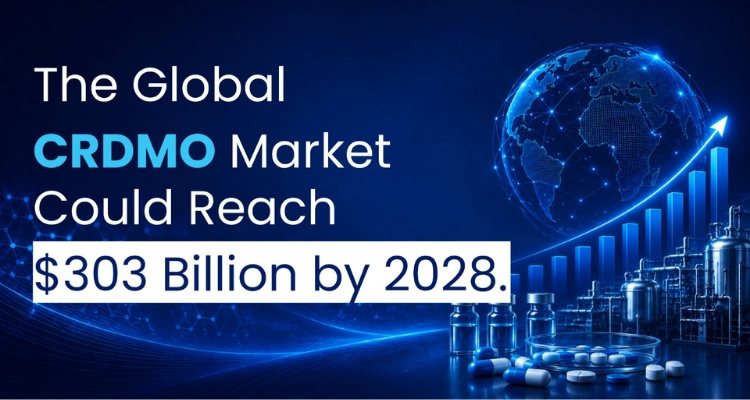
With the global CRDMO market expected to reach nearly $303 billion by 2028, the opportunity is no longer just about manufacturing medicines. It is about becoming an indispensable partner in pharmaceutical innovation.
Why Is the CRDMO Industry Growing?
Drug development has become significantly more expensive, more regulated, and far more complex than it was a decade ago.
Instead of building every capability in-house, pharmaceutical companies are increasingly partnering with specialised CRDMOs that can help reduce development timelines, improve efficiency, and scale manufacturing more effectively.
This structural shift is being driven by:
- Increasing complexity of biologics and advanced therapies
- Rising R&D costs
- Faster product development requirements
- Greater regulatory expectations
- Global supply chain diversification
The Biggest Competitive Advantage Isn’t Cost. It’s Trust.
Many investors assume pharmaceutical outsourcing is driven primarily by lower manufacturing costs.
In reality, trust is often the biggest competitive advantage.
Once a CRDMO becomes part of a commercial drug programme, replacing that partner is extremely difficult. Manufacturing processes, production facilities, and quality systems become deeply embedded within regulatory approvals and validated processes.
As a result, successful CRDMOs often benefit from:
- High switching costs
- Long-term customer relationships
- Stable revenue visibility
- Strong competitive moats
For investors, these characteristics make CRDMOs very different from traditional manufacturing businesses. Their value lies not just in producing medicines, but in becoming trusted long-term partners.
India’s Advantage Is Moving Beyond Cost
India’s pharmaceutical industry is no longer competing on affordability alone.
Today, global pharmaceutical companies increasingly evaluate partners based on their capabilities rather than their costs.
They look for companies with:
- Advanced manufacturing capabilities
- Strong regulatory compliance
- Robust quality systems
- Technology adoption
- Process development expertise
Indian CRDMOs have steadily invested in automation, specialised R&D, digital manufacturing, and advanced production facilities. As a result, many companies are moving higher up the pharmaceutical value chain and creating greater long-term value.
GCCs Could Become a Hidden Growth Driver
Another trend quietly reshaping the industry is the rapid expansion of Global Capability Centres (GCCs) in India.
These centres are no longer limited to support functions. Increasingly, they are becoming hubs for research, AI, digital engineering, regulatory affairs, and process optimisation.
Rather than simply supporting global operations, GCCs are helping create a stronger innovation ecosystem for India’s pharmaceutical industry.
China+1 Is Only the Starting Point
The China+1 strategy has undoubtedly created opportunities for Indian pharmaceutical companies.
However, diversification may help a company win its first customer.
Execution is what helps retain that customer for the next decade.
The businesses most likely to create long-term value will be those that consistently deliver quality, maintain regulatory excellence, and execute with discipline.
What Should Investors Monitor?
Capacity expansion often dominates headlines, but capacity alone does not create shareholder value.
Instead, investors should focus on whether companies are:
- Winning repeat business
- Moving into higher-value products
- Improving capacity utilisation
- Maintaining regulatory excellence
- Generating healthy returns on capital
Ultimately, capability compounds faster than capacity.
The Bigger Investment Opportunity
The CRDMO opportunity extends well beyond pharmaceuticals.
As the ecosystem continues to expand, it is expected to benefit industries such as speciality chemicals, laboratory equipment, industrial automation, engineering services, packaging, and digital manufacturing solutions.
This makes CRDMOs not only a healthcare opportunity but also a broader advanced manufacturing and innovation theme.
Conclusion
India has already established itself as one of the world’s leading pharmaceutical manufacturing hubs.
The next phase of growth is unlikely to be defined simply by producing more medicines. Instead, it will be driven by India’s ability to become a trusted global partner in pharmaceutical research, development, and manufacturing.
For long-term investors, the real opportunity lies beyond market size. It lies in identifying businesses that continuously strengthen their capabilities, deepen customer relationships, and execute consistently because those are often the companies that create enduring shareholder value.
Read More:
- Why Battery Chemicals Could Be India’s Biggest EV Opportunity
- Green Hydrogen and Battery Storage: India’s ₹12.2 Lakh Crore Capex Bet and the SME Opportunity
- India Is Now the 3rd Largest Renewable Energy Market: What It Means for Microcap Investors
- India’s Battery Energy Storage Requirement Forecasted to Grow From 1 GWH to 888 GWH
- What Every HNI Investor Must Know About SEBI’s AIF Regulations