







Introduction
When people think about the electric vehicle (EV) revolution, they usually think of battery manufacturers or EV companies, but one of the biggest opportunities may lie much earlier in the value chain in battery chemicals.
As countries work to reduce dependence on China and build more resilient supply chains, companies producing specialised battery materials are becoming one of the most important parts of the EV ecosystem, and for investors, this is a story about how global supply chains are changing and where long-term value could be created.
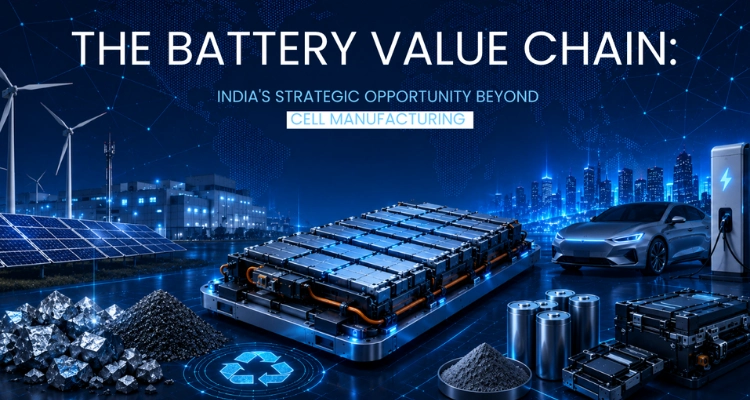
The Battery Value Chain
Before a battery powers an electric vehicle, it passes through several stages:
- Raw Materials (Lithium, Nickel, Cobalt, Graphite)
- Battery Chemicals (Cathodes, Anodes, Electrolytes)
- Cell Manufacturing
- Battery Pack Assembly
- Electric Vehicles & Energy Storage
Most conversations revolve around battery cell manufacturing.
However, a large part of the value addition actually happens in the battery chemicals that go inside those cells, and these materials determine how efficiently a battery performs, how long it lasts, how quickly it charges, and ultimately how much it costs.
Why Battery Chemicals Matter
Every lithium-ion battery is made up of several components, but three stand out.
Cathode (30-40% of battery cost)
The cathode is the most expensive part of a battery. It largely determines its energy density, charging speed, battery life, and safety.
Whether it is an LFP battery used in electric buses or an NMC battery used in premium EVs, manufacturing cathode materials requires advanced chemistry and specialised production processes. This is why companies operating in this space often enjoy higher value additions.
Anode (10-15%)
The anode stores lithium ions while charging.
Traditionally made from natural or synthetic graphite, newer technologies increasingly use silicon-based materials that can improve battery energy density by 20-40%.
Electrolyte (6-10%)
The electrolyte enables lithium ions to move between the cathode and anode, and without it, the battery simply wouldn’t function, as its quality influences fast charging, battery life, safety, and overall performance.
Together, these three components account for a significant share of battery costs and require deep technical expertise, making them attractive parts of the value chain.
Why Investors Are Paying Attention
Battery chemical companies operate in a business with several characteristics investors often look for:
- High entry barriers
- Technology-intensive manufacturing
- Long customer qualification cycles
- Sticky customer relationships
Battery manufacturers don’t change suppliers overnight.
Even a small change in chemistry can affect battery performance and safety. As a result, suppliers often undergo 12–24 months of testing before receiving commercial orders.
These relationships can last for years once they are approved.
India’s Emerging Opportunity
India is gradually building capabilities across several battery chemical segments.
Companies are investing in:
- Cathode Active Materials (CAM)
- Synthetic Graphite
- Iron Phosphate
- Electrolytes
- Electrolyte Additives
- Silicon-based Anodes
These products are essential for every lithium-ion battery produced.
As India’s EV ecosystem grows, demand for these specialised materials is also expected to increase.
The Bigger Trigger: FEOC
One of the biggest global developments driving this opportunity is a policy called Foreign Entity of Concern (FEOC).
The objective is straightforward.
Countries like the United States want to reduce dependence on battery materials sourced from China. Today, China dominates much of the global battery supply chain, including graphite processing, cathode materials, electrolytes, and lithium processing.
As FEOC regulations become stricter and exemptions gradually end by 2026, battery manufacturers are actively looking for alternative suppliers.
Many companies are adopting a “China +1” sourcing strategy, creating opportunities for countries such as India, Japan, South Korea, and Australia.
Why India Could Benefit
India already has several strengths that support this transition.
- A well-established speciality chemical industry
- Competitive manufacturing costs
- A rapidly growing domestic EV market
- Government support for advanced manufacturing
- Experience supplying global customers
Many Indian chemical companies already export specialised products worldwide, giving them experience in meeting international quality and regulatory standards.
This positions India well as global companies diversify their supply chains.
What Should Investors Watch?
While the opportunity is significant, execution will determine the winners.
Some key monitorables include:
- Has commercial production started?
- Are new plants being commissioned on time?
- Have companies secured customer qualifications?
- Are production capacities being utilised?
- Are margins supported by technology or just temporary shortages?
Headline announcements often attract attention, but long-term value is created when companies consistently execute and convert capacity into profitable growth.
Conclusion
The EV revolution is much bigger than electric vehicles alone, and behind every battery is a complex ecosystem of specialised materials, advanced chemistry, and global supply chains.
As countries seek to reduce dependence on a single geography and battery demand continues to rise, battery chemicals are emerging as one of the most important parts of this transition.
For investors, the opportunity lies in identifying who builds the most batteries. It may lie in identifying the companies supplying the specialised materials that every battery requires. Structural opportunities often create the tailwind, but disciplined execution determines who ultimately benefits.
Read More:
- Gujarat’s Wire-Free City Mission: A Bold Step Forward, But the Real Test Lies Underground
- India Is Now the 3rd Largest Renewable Energy Market: What It Means for Microcap Investors
- India’s Ayurveda Sector: From Tradition to a Scalable Growth Industry
- Semiconductor Mission 2.0: How Microcaps Are Powering India’s Electronics Revolution
- Green Hydrogen and Battery Storage: India’s ₹12.2 Lakh Crore Capex Bet and the SME Opportunity