








Introduction
Every May, India’s results season arrives – and for SME and microcap investors, it is the richest window of the year. These are companies where a single quarterly filing can change the picture entirely, often before the broader market even catches on.
The catch is that SME results demand a different kind of reading. There is no analyst consensus to anchor against, no earnings call to fill in the gaps. Disclosures are leaner, footnotes carry more weight, and the metrics that matter tend to sit in the cash flow statement – not the headline profit number everyone reads first.
At Steptrade Capital, India’s first SME exchange-focused Category II AIF manager, reading quarterly results is central to how the investment team monitors portfolio positions and evaluates new ones. Here is the framework behind that analysis.
Key Takeaways
- India’s Macro Backdrop Is Strong Heading into Q4: India’s real GDP grew 7.6% for FY2026 per MoSPI’s Second Advance Estimates. Manufacturing delivered double-digit growth for the fifth consecutive quarter – a solid tailwind for industrial SMEs reporting this season.
- The RBI’s Repo Rate at 5.25% Shapes Borrowing Costs: The RBI held the repo rate at 5.25% at its April 2026 MPC meeting. SME companies carrying working capital debt will show elevated interest expense in Q4 – account for this before drawing conclusions about net margins.
- Revenue Growth Means Nothing Without Context: A 20% revenue jump looks impressive until it sits against a sector growing 35% or a margin that compressed 400 basis points. Always benchmark growth before arriving at any judgment.
- Cash Flow from Operations Is the Most Honest Number: SME companies can and do report accounting profits while burning cash. The operating cash flow line is the hardest number to dress up and the most revealing about what is happening in the business.
- Three Balance Sheet Metrics Flag Hidden Stress Early: Debt-to-equity, receivable days, and promoter pledging reveal financial pressure well before it ever surfaces in the P&L. Track them across four consecutive quarters, not just the latest one.
- SEBI Risk Reminder: SME and microcap stocks carry higher price sensitivity, lower liquidity, and thinner public disclosures than large-cap equities. All investment decisions should be based on independent research. Past performance does not guarantee future results.
Start With the Macro Picture
Numbers do not exist in a vacuum. Before opening any company’s quarterly filing, the first question is simple: what was the economy doing while this business was operating? India’s real GDP grew 7.6% for FY2026 per MoSPI’s Second Advance Estimates released in February 2026. That is the water every company was swimming in.
A 7.6% GDP year raises the bar significantly. Any SME that could not grow meaningfully in that environment has something company-specific going wrong – and that is worth understanding before drawing any investment judgment.
The RBI held the repo rate at 5.25% at its April 2026 MPC meeting, maintaining a neutral stance. For SME companies with significant working capital borrowings, interest costs in Q4 remain elevated compared to the rate-cycle lows of FY2022-23. Before concluding that a company’s net margins are weak, check whether rising interest expense is the main explanation.
Macro context sets the performance benchmark. A company growing revenue 12% when the sector grew 25% is losing ground, not gaining it. Know what the sector was doing before deciding whether a company’s numbers are strong or just adequate.
Revenue and Margins: Reading Past the Headline
Revenue is always the number everyone looks at first. Experienced SME investors learn quickly to look past it. The real question is not how much revenue grew – it is why, and whether that growth is likely to continue.
Growth from one-time contracts or related-party transactions reads very differently from growth driven by expanding customer relationships and repeat orders. In the SME segment, the gap between a genuine growth story and a single strong quarter can be enormous – and the difference usually sits in the notes to accounts, not the headline P&L.
Manufacturing posted double-digit growth for the fifth consecutive quarter in FY2026 – a strong tailwind for SME manufacturers. Even so, margin compression in that environment is a yellow flag. If revenues rose 20% and operating profit only rose 8%, something is eating into the economics – raw material pressure, logistics costs, or aggressive pricing to win new customers. Each scenario carries a different implication for where the business is headed.
One more thing worth checking: whether growth is coming from a diversified order book or from one or two large customers. Revenue concentration risk in SME companies is persistent and real, and it almost never shows up cleanly in any ratio.
Cash Flow and the Balance Sheet Tell the Real Story
This is where the gap between investors who understand SME businesses and those who only skim results become most visible. A company can report perfectly respectable profits while quietly bleeding cash – and in the microcap segment, this happens far more often than most people expect.
Pull the cash flow statement and go straight to operating cash flow. If net profit is ₹5 crore but operating cash flow is near zero or negative, receivables are building or inventory is piling up. That is a business absorbing stress that has not yet made it into the P&L.
On the balance sheet, three numbers deserve consistent attention. Debt-to-equity tracks leverage and how exposed the company becomes if revenues dip. Receivable days and inventory days reveal whether the business is running efficiently or quietly building a working capital problem. Promoter pledging, disclosed in every quarterly shareholding pattern, is often the earliest visible sign of financial pressure before it reaches the formal accounts.
Track all three across at least four consecutive quarters. A single bad quarter can always be explained. A deteriorating trend across four cannot – and patterns in SME investing carry real weight.
Red Flags That Deserve a Closer Look
Some things in a results filing should make an investor stop and look more carefully. Related-party transactions growing faster than revenues deserve a direct question, especially when the counterparty is a promoter-linked entity. A mid-year auditor change at any microcap company is almost always worth attention, no matter how routine the explanation sounds.
The red flag that gets missed most often is a sharp jump in other income. When core operations are flat but other income has surged through asset sales, forex gains, or inter-corporate loans, the headline profit looks better than it is. Earnings quality has dropped even as the reported number has risen – and this pattern shows up regularly in SME results.
Inventory days are worth watching in any quarter where demand is softening. SME manufacturers sometimes build stock in anticipation of orders that do not arrive, and the write-downs come later – quietly buried in one-off items. Tracking inventory days quarter over quarter is one of the cleaner ways to catch this well before it becomes a formal announcement.
And when net profit rises but taxes paid stay flat or fall, it is worth understanding the reason. Sometimes there is a perfectly legitimate explanation. Sometimes there is not. Either way, the question is worth asking.
How Steptrade Capital Reads Q4 Results
At Steptrade Capital, quarterly results analysis starts before the filings land. The team tracks sector-level data continuously – procurement trends, input prices, order book signals – so when the numbers arrive, there is already a view of what they should look like. Surprises, in either direction, become far more meaningful against that backdrop.
The lens is quality of earnings, not headline growth rate. A company growing revenue 15% with expanding margins, positive operating cash flow, and a tightening balance sheet is more interesting than one growing 30% on compressed margins with deteriorating receivables. The second company screens better. The first is performing better.
For HNI and family office investors reading SME results on their own, the most important habit is consistency. Tracking the same five to seven metrics across four to five quarters – rather than reacting to any single result – is where the genuine analytical edge lives in this segment.
SME and microcap investing carries real risks: lower liquidity, thinner disclosures, and sharper price sensitivity to news. These are not reasons to stay away. They are reasons to enter with the right research backing and monitoring discipline – not just a screener and a headline.
All investments in securities are subject to market risk. Past performance does not guarantee future results. Investment decisions should be based on independent research and a clear understanding of personal risk tolerance.
Conclusion
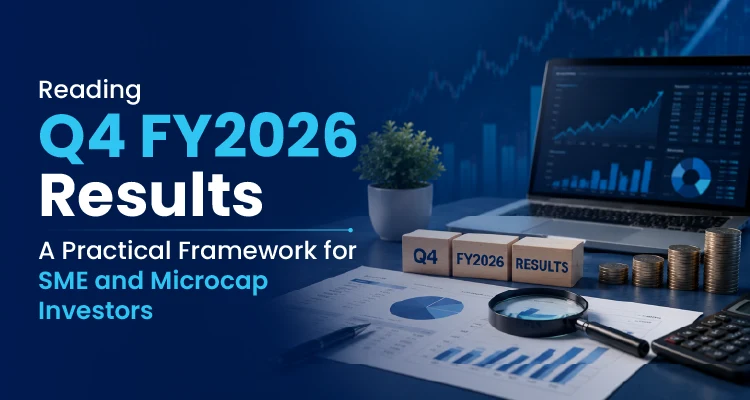
Q4 FY2026 results season is an opportunity – but only for investors who know what to look for. 700 companies are now listed on NSE EMERGE alone, carrying a combined market capitalization of over ₹2.22 lakh crore. Within that universe, quality varies sharply – and surface-level reading is where even well-intentioned investors go wrong.
The investors who build consistent returns in the SME and microcap segment are not the ones reacting to screener results or quarterly surprises. They are the ones with a clear framework, applied consistently, quarter after quarter. That is not exciting work. But it is what compounds.
Steptrade Capital’s SEBI-regulated AIF structure is built around exactly this kind of analytical discipline – applied to one of India’s most dynamic and underserved investment segments. To learn more about how our funds approach SME investing, visit Steptrade Capital.
Frequently Asked Questions
1. What is the macro backdrop for reading Q4 FY2026 SME results?
India’s real GDP grew 7.6% for FY2026 per MoSPI’s Second Advance Estimates, with manufacturing posting double-digit growth for the fifth straight quarter. The RBI held the repo rate at 5.25% at its April 2026 MPC meeting – meaning elevated borrowing costs will show up in Q4 interest lines and weigh on net margins for leveraged SME companies.
2. Why is cash flow from operations more important than net profit in SME results?
Net profit can be shaped by accounting choices, one-time income, and deferred tax timing. Cash flow from operations reflects the actual cash the business generated from its core activity – the number that is hardest to dress up. A persistent gap between high profits and low operating cash flow is one of the clearest early signals of financial stress in an SME company.
3. What are the top red flags to look for in SME quarterly results?
The main red flags: related-party transactions growing faster than revenues, a mid-year auditor change, a sharp rise in other income against flat core revenue, inventory buildup in softening demand conditions, and a growing gap between reported profit and taxes actually paid. Any one of these deserves a closer look before any investment decision.
4. How does the RBI repo rate affect SME companies’ Q4 results?
At 5.25%, the repo rate directly sets the floor for working capital borrowing costs. SME companies with significant short-term debt will carry higher interest expense in Q4 than they did two or three years ago. Investors should track interest expense as a share of revenue across consecutive quarters – a rising trend here compresses net margins even when the business is otherwise doing well.
5. What three balance sheet metrics matter most when reading SME quarterly results?
Debt-to-equity tracks leverage and squeeze risk when revenues slow. Receivable days and inventory days reveal working capital efficiency – or the build-up of stress not yet visible in the P&L. Promoter pledging, disclosed every quarter, often surfaces financial pressure before it enters the formal accounts. Tracking all three across four consecutive quarters tells a far richer story than any single snapshot.
6. How should SME results be benchmarked to avoid misreading them?
Every number in an SME result needs context: the sector’s growth rate, the company’s own trend across prior quarters, and the macro backdrop. A company growing 15% in a sector growing 30% is quietly losing share. A company holding margins flat through sharp input cost inflation may be doing something exceptional. The number alone rarely tells the story.
Read More:
- Q4 FY2026 Earnings Preview: What SME and Microcap Investors Should Expect
- SME & Microcap Investing Through AIFs: A Family Office Perspective
- The Rise of SME Companies: Path to Becoming the Next Microcap and Smallcap Giants
- Biopharma SHAKTI: India’s ₹10,000 Crore Healthcare Push and the SME Opportunity
- Semiconductor Mission 2.0: How Microcaps Are Powering India’s Electronics Revolution